

Azeroth
- This article is about Azeroth, the planet. For the titan world-soul slumbering at the core of the world, see Azeroth (titan). For other uses, see Azeroth (disambiguation).
 Azeroth Azeroth | |
|---|---|
| Level: 1-50, 60-70 Battle Pet Level: 1 - 25 | |
 Azeroth in the Shadows of Argus cinematic | |
| Type | World |
| Capital(s) | Various |
| Races | Various |
| Ruler(s) |
Alliance Horde Dragon Aspects Old Gods Titan-forged Wild Gods Scourge Elementals Independent organizations |
| Location | Great Dark Beyond |

“This is Azeroth. A dangerous, beautiful, magical, and inspiring world. A world filled with discovery, innovation, and wonder. A world worth fighting for. A world worth protecting.”
- — Ultimate Visual Guide, pg. 11
Azeroth is the name of the world in which the majority of the Warcraft series is set. At its core dwells a slumbering world-soul, the nascent spirit of a titan. Long ago, it was invaded by the Old Gods, eldritch abominations from the Void. When the Pantheon arrived, the titans imprisoned the Old Gods deep beneath the earth, before healing and ordering the world, and seeding life across the planet. A great fount of magic that would nurture the land was placed at the center of Kalimdor, known as the Well of Eternity.
One day, attracted by the Well, the demonic armies of the Burning Legion found Azeroth and caused the Sundering of the world. After the Third War, two major powers emerged, the Alliance and the Horde. Although ravaged by inner conflict and external threats, the peoples of Azeroth have, somehow, always managed to survive.
Geographical features

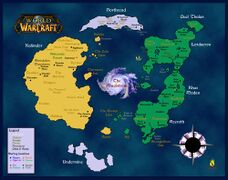
The world of Azeroth is comprised of four major continents, with a number of islands scattered about them. The Great Sea is located in between the four landmasses, and at the center of it is the Maelstrom — a massive chaotic whirlpool and all that remains of the ancient Well of Eternity. To the east lies the Eastern Kingdoms, which is made up of three major regions. Azeroth to the south, Khaz Modan in the middle, and Lordaeron to the north, these last two separated by a channel and connected by the dwarven bridge of Thandol Span. To the west, across the ocean, is Kalimdor, which is also divided into three regions. North of the sea lies the frozen continent of Northrend, and to the south the newly discovered landmass of Pandaria, which had been isolated and shrouded by dense mists during the last 10,000 years. The islands of Zandalar, Kul Tiras, and the Broken Isles have been of major importance in recent events.
Before the War of the Ancients all these continents and islands were one single landmass known as Kalimdor, the name which would live on in the modern western continent. At the end of the war, with the implosion of the Well causing the Great Sundering, the landmass shattered into four continents while the sunken land in between became the Great Sea.
The Forbidding Sea is the expanse of water to the east of the Eastern Kingdoms and the Veiled Sea sits west of Kalimdor. South of Pandaria lies the South Seas.
Highmountain on the Broken Isles and Mount Neverest in Kun-Lai Summit are two of the tallest mountains on the planet.[1][2]
Azeroth has two moons, the White Lady and the Blue Child.
When Malygos diverted the magical powers that coursed beneath Azeroth to the Nexus, the world's crust splintered, and the resulting unstable rifts tore the very fabric of the magical dimension of the Twisting Nether.[3]
History
- Main article: Timeline
Ancient times

As the titan Pantheon traveled the cosmos, ordering worlds and searching for additional titans, a miraculous new world, which would later become known as Azeroth, was taking form in a distant corner of the Great Dark.[4] Forged by primordial infernos,[5][6] the world hosted a nascent titan who stirred to life within its core.[4] As this world-soul developed, she[7] drew in and consumed much of the fifth element, Spirit, causing Azeroth's native elementals to grow increasingly erratic and chaotic. The four Elemental Lords — the ruthlessly cunning Al'Akir the Windlord, the brutish Ragnaros the Firelord, the protective Therazane the Stonemother and the wise Neptulon the Tidehunter — reveled in strife, constantly clashing with each other and keeping the world in constant flux during the elemental wars. One day, however, the Old Gods arrived, plummeting down from the Great Dark and embedding themselves in the world's surface. With the aid of their servants, the aqir and the n'raqi, the eldritch horrors established the Black Empire, and though the Elemental Lords attempted to extinguish what they saw as a threat to their dominion, the elementals were eventually enslaved.[4]

Azeroth eventually attracted the attention of the wandering titans, who fought the Old Gods in a war of ordering the world and shaping it with artifacts known as the Pillars of Creation.[8] Though the elementals were powerful beyond mortal comprehension, their combined forces could not stop the mighty titans. One by one, the elemental lords fell, and their forces dispersed. The Pantheon shattered the Old Gods' citadels and, after killing at least one, they cast the remaining ones down into eternal imprisonment deep beneath the earth, the place of their confinement hidden from all and their powers bound until the end of time. With the elementals' departure, nature calmed, and the world settled into a peaceful harmony. With the help of their constructs (the ancestors of dwarves, gnomes, vrykul, and giants), the titans paved new landscapes and shaped the world as they saw fit, allowing life to flourish on Azeroth. Satisfied, the titans built hidden cities for their construct creations and created the Great Aspects to guard the planet before leaving on their cosmic journey.
Before leaving, the titans created an enormous lake filled with arcane energy, known as the Well of Eternity, at the center of the great landmass of Kalimdor. The Well accelerated the cycles of growth and rebirth, and soon intelligent races evolved from the land's primitive life forms. The trolls were among the first and most prolific. Though the various troll tribes varied greatly in culture and traditions, they all shared a common religion centered around the elusive Wild Gods, or "loa", mysterious and powerful beings that originated from Azeroth itself. The Zandalari, the most powerful troll tribe, established the temple city of Zuldazar and a great civilization upon the summit of the sacred Zandalar mountain range, where many of the trolls' honored loa dwelt.[4] Soon, however, splinter factions of the Zandalari left Zuldazar seeking war and conquest, establishing the Gurubashi and Amani empires. Later, the aqiri empire of Azj'Aqir rose in the west, forcing the trolls to better defend their major holdings. With pressure from their trollish enemies, the empire of the aqir collapsed and split into the qiraji, nerubian, and mantid kingdoms.

After their war with the aqir, the trolls controlled most of Kalimdor. A group of dark trolls distanced themselves from their warlike brethren, instead dwelling in cavernous tunnel networks beneath Mount Hyjal and surrounding areas. Eventually, some of the dark trolls began migrating towards the heart of Kalimdor, establishing villages along the way and in time re-discovering the Well of Eternity. One of the dark troll tribes settled upon its shores, and the magic of the Well uplifted them into powerful and virtually immortal beings that would later become known as the night elves, or "kaldorei".[4] Using the potent magics of the Well of Eternity, the elves broke troll influence in many regions and established a magocratic empire. At the height of kaldorei power, however, their reckless use of magic attracted the demonic armies of the Burning Legion. Queen Azshara and her Highborne summoned the Burning Legion into the world, sparking the War of the Ancients. The night elves not loyal to Azshara, along with their dragon and Ancient Guardian allies, were forced to destroy the Well, which caused a Great Sundering that split the ancient supercontinent of Kalimdor apart, creating several smaller continents: Northrend, Pandaria, the Eastern Kingdoms (including Azeroth, Khaz Modan, and Lordaeron), and "Kalimdor".
Following the war, there was a schism among the elves. The night elves abandoned their arcane heritage, instead embracing druidism under the tutelage of the first druid, Malfurion Stormrage. The kaldorei, with the help of the Great Aspects, planted the World Tree Nordrassil on top of the last remaining waters of the Well of Eternity, in order to protect and heal Azeroth. However, the Highborne refused to give up arcane magic. Fearing their use of magic would cause another demonic invasion, the night elves banished the Highborne from Kalimdor. Renaming themselves high elves, the former servants of Azshara sailed across the Great Sea. They settled in the north of Lordaeron, establishing the mighty kingdom of Quel'Thalas. There, they rediscovered the Amani Empire, who still had a strong force over the land. Soon the two cultures clashed in what became known as the Troll Wars. With support from the young race of humanity, the high elves broke and scattered what remained of the Amani empire.
Meanwhile, on Kalimdor, the night elves were forced to fight with the reawakened silithid and their qiraji masters, in what would be called the War of the Shifting Sands. Bent on exterminating all non-insectoid life, the qiraji clashed with the night elves on the sands of Tanaris. With the help of their ancient dragon allies, the kaldorei were able to defeat the insectoid empire, and closed the Scarab Wall in order to seal the insectoid race inside Ahn'Qiraj, thus ending the war.
Living in peace within their mountain homes, the dwarves, cursed descendants of the titan-forged earthen, prospered. However, when their high king, Modimus Anvilmar, passed, a struggle for power over the capital city of Ironforge began. The War of the Three Hammers ensued, forcing dwarf against dwarf and split the dwarves into three clans; the Bronzebeard clan, the Wildhammer clan and the Dark Iron clan. Eventually, the Bronzebeards defeated the other two and banished them from the city. The Wildhammers went north and founded the city of Grim Batol, settling the Twilight Highlands and the Hinterlands. The Dark Irons went south and founded the city of Thaurissan. Angered by their defeat, the Dark Irons prepared two armies to destroy their cousins. However, both of these armies were defeated. Combining their forces, the Bronzebeard and Wildhammer marched to Thaurissan to end the Dark Irons once and for all. Sensing impending defeat, Sorcerer-thane Thaurissan accidentally summoned Ragnaros the Firelord into Azeroth. The resulting destruction formed Blackrock Mountain and halted the advance of the Bronzebeard and Wildhammer armies, but doomed the Dark Irons to centuries of servitude to the Firelord.
Great Wars
Though the Legion constantly sought to re-enter Azeroth, the Council of Tirisfal, through its agent, the Guardian of Tirisfal, ensured that the demons were kept at bay. However, thousands of years after the War of the Ancients, the Burning Legion attempted to destroy Azeroth once more, this time indirectly. The demon lord Kil'jaeden forced the once peaceful orcs and ogres of Draenor into Azeroth. Manipulating the orc Gul'dan and possessing the human Medivh, the last Guardian of Tirisfal, the Legion was able to open a Dark Portal between both worlds, and the orcs poured through into Azeroth. The extended conflict with these alien invaders became known as the First and Second Wars, during which time the Horde destroyed the Kingdom of Azeroth, as well as establishing strongholds in Blackrock Mountain, Alterac Valley, Zul'Dare, and the Swamp of Sorrows. However, the mighty Horde was eventually broken and scattered by an Alliance of high elves, dwarves, and humans. Feeling the effects of their demonic blood rage dissipate as they languished in internment camps, the orcs were able to remember their peaceful, shamanic roots. Sensing this change, Thrall of the Frostwolf clan set about establishing a new Horde.
Angered by the Horde's failure, the Burning Legion prepared for yet another invasion, the culmination of their efforts, on both continents. The Legion sent its pawn, the Lich King to undermine the Azerothian defenses. After establishing his base in Northrend and defeating the nerubians in the War of the Spider, the Lich King set loose in the East a plague of undeath on the Alliance that the Legion so despised. This undead Scourge quickly broke the northern powers, demoralizing the people of the Eastern Kingdoms in preparation for a Legion offensive. Lured to the north by the Lich King, Prince Arthas of Lordaeron became his death knight pawn and the instrument of his liberation from the Legion's grasp. The Scourge under Arthas scattered the Knights of the Silver Hand, obliterated Lordaeron, and broke the power of the Sunwell in Quel'Thalas.
In the West, the demons and their satyr allies made a more direct assault on their old kaldorei enemies. In desperation, the elves turned to Illidan, a demon hunter from the War of the Ancients who had violated druidic law and had been imprisoned for ten thousand years. During the course of the conflict, Illidan was persuaded by the insidious Arthas to attack the demon known as Tichondrius and drink from the Skull of Gul'dan (a small part in the Lich King's greater scheme to emancipate himself from his Legion jailers).
Through the machinations of the then-cleansed Medivh, leaders of the New Horde and the Alliance were drawn to Kalimdor. While traveling Thrall's Horde forged powerful alliances with the Darkspear exiles and the native tauren of Kalimdor. In Kalimdor, the Alliance and Horde joined with the night elves to thwart the Legion advance into Hyjal Summit, where the World Tree Nordrassil was vulnerable to demonic attack. Archimonde, the leader of the daemonic invasion, as well as most of his followers, were defeated in the Battle of Mount Hyjal.
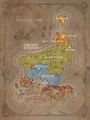
Map of the forest troll, human, and high elven territories in the Eastern Kingdoms
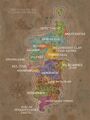
The territories of the Eastern Kingdoms prior to the First War
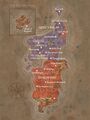
Territories of the Horde and the Alliance during the Second War


Recent times
Concerned with the separatist Scourge, Kil'jaeden solicited the half-demonic Illidan into destroying the source of the Lich King's power. With the aid of his naga allies, who he had recalled from the Maelstrom, he succeeded in breaking at least some of the Lich King's power. Hounded by his night elf jailers and the seething blood elves, Illidan was unable to complete his task. Suffering under the effects of magical withdrawal, the blood elves were persuaded to enter into the ranks of the Illidari. Fearing Kil'jaeden's wrath, Illidan and his allies fled to the decimated world of Outland. There, Illidan toppled the regime of Magtheridon to become the new ruler of Outland.
The weakening of the Frozen Throne allowed some of the Scourge to regain their free will. Under the Banshee Queen Sylvanas Windrunner, these Forsaken managed to force the Legion-controlled undead from the ruins of Lordaeron and establish a stronghold beneath its streets. Arthas, meanwhile, fought a desperate battle in Northrend to save his master from the newly empowered lord of Outland, who under increasing threats from Kil'jaeden had taken up his quest to destroy the Lich King once more. Illidan was defeated by Arthas and retreated to Outland, while Arthas merged with the malicious spirit of the Lich King.
Following the Third War, the political landscape of Azeroth changed greatly. The orcish nation of Durotar was established in Kalimdor, as was the human colony of Theramore. The night elves joined the Alliance, and the Forsaken joined the New Horde. The remaining citizens of Lordaeron, broken by the Scourge, formed new regimes: the xenophobic and zealous Scarlet Crusade and the compassionate Argent Dawn, citizens that stayed in Lordaeron along with the refugees that fled to the remaining Alliance strongholds such as Stormwind. With the armies of the Horde and the Alliance decimated by the Third War, the defense of their borders became the responsibility of small bands of heroes and adventurers.
At some point, Azeroth had been victim to massive mystic struggles, which tore magic currents from once stable channels. The mages of the Wizard's Sanctum struggled to determine the effects these changes had caused, and some of them feared the worst, as the flow of magic in Stormwind City and Elwynn Forest was somehow altered.[9]

After a thousand years of waiting, the Silithid stirred within the confines of their city. Unleashing its armies once more, the Old God C'Thun wished to destroy all life on the world and leave nothing but chaos in its wake. Silithid began attacking the areas all around their fortress, attracting the attention of both the Alliance and Horde. With no other choice, the two were forced to work together and created the Might of Kalimdor. With the help of the dragonflights, they recreated the  [The Scepter of the Shifting Sands]. With it, they used its power to unlock the Scarab Wall and entered the ruined city. There, they defeated the Silithid and their Qiraji masters. Adventurers fought their way through the city and finally reached the Chamber of C'Thun. After a long battle with the great beast, C'Thun was defeated and his remnants were brought to Caelestrasz. And so, the Ahn'Qiraj War came to an end.

After major threats in Silithus were neutralized by Horde and Alliance forces in the Qiraji War-Effort, the power-blocks once more formed a tentative alliance in response to the opening of the Dark Portal. The Horde formed an alliance of necessity with the blood elves, while the Alliance warily welcomed the draenei exiles into their ranks. The invasion of Outland was fought on multiple fronts and against numerous factions. The greatest threat was the Burning Legion, who, after their defeat on Hyjal, were mobilizing their forces for yet another invasion of Azeroth, this time via Outland. Finally, Illidan's hegemony in Outland proved to be short-lived. After losing the support of Kael'thas Sunstrider, whose addiction to fel energy led him to side with the Legion, the scattered coalition of naga, fel orcs, and demons called the Illidari were defeated by Sha'tari and Azerothian forces. After the destruction of the Illidari and his own defeat, Kael'thas returned to Azeroth, where he planned to restore his beloved Sunwell as a means of summoning Kil'jaeden, his new master, into Azeroth. To counter this, the opposing factions in Shattrath, the Aldor and Scryers, joined with the Blood Knights of Quel'Thalas. This Shattered Sun Offensive marched upon the Sunwell, slaying Kael'Thas and forcing Kil'jaeden back to the Twisting Nether. Using the power of the fallen naaru M'uru, the Prophet Velen ignited the Sunwell, thus returning the blood elves' power.
Dragon Aspect Malygos after thousands of years regained his sanity and saw that magic had run amok throughout the world of Azeroth, and blamed this on the reckless use of magic by the mortal races that had arisen in his ten millennia of isolation. Using the powerful Arcanomicon, he began to siphon magic from the world. Realizing that Malygos had become a very real threat, the Kirin Tor used what remaining powers they had to magically transfer the rebuilt city of Dalaran to the skies of Northrend to combat their new foe in what would be called the Nexus War. Malygos' actions have also incurred the ire of the Red dragonflight, led by the Dragonqueen Alexstrasza. Forming an alliance with the other dragonflights, the Wyrmrest Accord sought to end Malygos' war. The final blow against Malygos was struck thanks to the efforts of mortal heroes where they were joined by drakes of the red dragonflight. With the combined strength of the heroes and the drakes, Malygos was defeated.

After years of sitting dormant, the Lich King awoke and began his invasion of Azeroth. Defending their major holdings from a Scourge incursion in Kalimdor and Azeroth, the Horde-Alliance blocks, emboldened by their conquest of Outland, launched a final joint offensive on the Scourge forces in Northrend, starting the War against the Lich King. Their efforts were bolstered thanks to an internal rebellion against the Scourge by the Knights of the Ebon Blade and the newly created Argent Crusade, led by the paladin Tirion Fordring. The Horde-Alliance entente ended with the crisis at the Wrathgate. Their joint forces were routed at the gates to Icecrown when a separatist faction of Forsaken bombarded the living and dead alike with their new strain of blight. The fragile truce was shattered by this event, and both sides almost entered into an open war once again. With the help of the Ashen Verdict, their separate efforts were enough to finally breach the walls of Icecrown. In a final battle, Tirion and the combined forces of the Horde and Alliance shattered Frostmourne and ended the Lich King. Highlord Bolvar Fordragon took the responsibility to became the new undead king, in order to keep the Scourge forces at bay.
Soon after, the Nightmare Lord launched his attack against Azeroth from the Emerald Nightmare. Forcing people to lay trapped within their own nightmares, he used these victims to attack those unaffected by the nightmare. And so, the War Against the Nightmare began. However, led by Malfurion Stormrage, the people from Azeroth were able to fight back. Using their dreamforms, they took the battle to the Emerald Nightmare where they freed Ysera and confronted the Nightmare Lord and his army. With the help of druids on the waking world, Malfurion was eventually able to destroy the Nightmare Lord's power source, both in the Emerald Dream and on Azeroth. People awoke from their nightmares and things returned to normal. The Horde and the Alliance tried once again to make a treaty, mostly because both groups needed to recover from the recent wars. But this treaty was not meant to last.

Deep within Deepholm, the domain of earth in the Elemental Plane, the corrupted Dragon Aspect Deathwing had been waiting, recovering from the wounds of his last battle against Azeroth and biding his time until he could reforge the world in molten fire. Some time after the end of the War against the Lich King, Deathwing returned to Azeroth, and his eruption from Deepholm massively damaged the world. The kingdoms of Azeroth witnessed seismic shifts in power, the kindling of a war of the elements, and a return to open war between the Horde and the Alliance. With the help of the Twilight's Hammer led by Cho'gall and the powerful twilight dragons, Deathwing sought out to destroy the world in molten flame. Coming to the conclusion that the only way to defeat the great dragon, the Aspects and Thrall agreed they would need the Demon Soul to end him. While Thrall retrieved it from the past, the Wyrmrest Accord and their mortal allies battled the forces of Deathwing at Wyrmrest Temple. On his way to hand over the Demon Soul, Thrall was attacked by the new leader of the nearly extinct Twilight's Hammer, the Twilight Father. After defeating him, Thrall returned the Demon Soul to the Aspects who empowered it. After unleashing it's wrath upon Deathwing, the great dragon was finally destroyed at the Maelstrom. With the powers of the Aspects gone, the Age of Mortals began.
Another threat that the world faced was in the form of the Darkstorm, a force that could annihilate all life, and Highlord Xaraax. Thanks to an unknown naaru and the Order of the Seven Suns led by Greydon Thorne, the world was protected until his brother Silverlaine betrayed the order, joined the Burning Legion, and destroyed the naaru with the Diamond Blade, shattering the sword in the process and blasting its shards across the world. The naaru's essence survived in the crystal shards so the Darkstorm couldn't come. The naaru guided Greydon, and later his son Aramar and Makasa Flintwill to collect the shards and reforge the sword. The same order gave Xaraax to Silverlaine, now known as Malus, and his Hidden. Upon capturing the Thornes, Makasa found and reforged the Blade. Wanting to free their family from Xaraax's citadel in Hellfire Peninsula on Outland, she raised an army of murlocs, gnolls, yetis, and various individuals. Makasa led the force to the citadel, fighting her way to the top to Xaraax. He managed to take the blade and began corrupting it. However, he had deemed Malus unuseful, and now, Malus took the dreadlord's former fel sword, impaled him on it and tossed him into the Darkstorm. The fight went on, but eventually, the Thornes and their friends bested the majority of the demons and the evil Hidden. Outnumbered, Makasa, with assistance from Aram, quickly ended his life. With Malus' demise, the Darkstorm evaporated.[10]
After the world was finally free from the grip of Deathwing's destructive rampage, the conflict between the Alliance and Horde began to intensify to an unprecedented scale, especially after the Battle for Theramore which led to a massive uproar in the other Alliance nations and a full retaliation. The discovery of the Wandering Isle, the pandaren clans of Tushui and Huojin, and their newly found allegiance have brought the tales of their mystical homeland of Pandaria to the attention of the warring factions, which hope to gain the favor of its inhabitants and gain their natural resources, as the land is undamaged by the Cataclysm's effects.
The arrival of the Alliance and Horde in Pandaria and their war led to a large disturbance in the emotional harmony of Pandaria. The newcomers' hate, anger, violence, doubt, despair, fear, and pride manifested as Sha, ancient deadly creatures created by the Old God Y'Shaarj's last breath. For thousands of years, the pandaren learned to contain their negative emotions, in turn, to contain the Sha from wreaking havoc. Brave adventurers managed to purge the Sha one by one, but as they did so, other forces were at work. The mogu and their Zandalari allies resurrected Lei Shen the ancient emperor of the mogu. The mantid of the lands beyond the Serpent's Spine fell under the influence of the Sha of Fear, leading them to attack the great wall separating them from pandaren lands. Also attacking the nomadic yaungol, forcing them to also attack the pandaren to escape. Lei Shen's forces gathered at his seat of power to prepare for a great invasion of Pandaria. The Alliance and Horde were quick to land forces on the island to stop Lei Shen, and he was soundly defeated and killed forever at the steps of his throne. The power-hungry Warchief of the Horde Garrosh Hellscream began to attempt to use Sha corruption to infuse Horde warriors. After discovering a terrible hidden artifact through goblin excavation, he used its power to corrupt the great Vale of Eternal Blossoms, killing most of the Golden Lotus and Shado-Pan in the process. Returning to Orgrimmar, he built a great underground citadel for his plans of conquering Azeroth and creating a pure orcish Horde. His actions eventually led a rebellion in his ranks to ally with the Alliance and lay siege to Orgrimmar. Most of Garrosh's followers were killed, captured or happened to escape during the chaos of the battle, the war between the Alliance and Horde was proclaimed to have ended, and the rebellion took control of the city and began to rebuild. Garrosh was then taken to Pandaria to await trial.

Garrosh escaped with the help of Kairozdormu to an alternate timeline of past Draenor. The former warchief created the Iron Horde and had the two universes connected through the Dark Portal. The Iron Horde's invasion force, the Ironmarch, attacked and razed the settlements of Blasted Lands, eventually triggering the heroes of the Horde and Alliance for a counterattack to Draenor itself. The campaign in Draenor resulted in demons taking over the Iron Horde thanks to the alternate Gul'dan. When the natives with the Azerothian forces defeated corrupted orcs and their demonic masters, Gul'dan was sent to the Twisting Nether by Archimonde. From there the diabolical orc was sent to Azeroth and he opened a portal for the demons on the Broken Isles. Pouring from the Felstorm above the Tomb of Sargeras, the Burning Legion began their third invasion of Azeroth.
Azeroth ultimately survived the invasion and ended the Burning Crusade, but not without scars. Sargeras impaled his sword into Azeroth in Silithus forming the Wound in the World. Cracks began occurring all across the planet's surface, the planet hemorrhaging its 'life-blood,' spilling to the surface as a blue-gold substance. As it emerged, it crystalized into thrumming spires reaching towards the sky.[11] The scrambling over this new substance would ignite the conflict between the Alliance and Horde. The two sides recruit new allies to bolster their depleted ranks.
Following the defeat of N'Zoth and his Black Empire at Ny'alotha, Magni Bronzebeard declared that Azeroth was made free of the grasp of the Old Gods.[12]
Inhabitants
All native life on Azeroth can trace its roots back to one of four ancient sources: the wild elementals, the seeping void of the Old Gods, the titan Eonar and the Emerald Dream, or the titan constructs who suffered the curse of flesh.[13]
Native
-
Wild God heritage

 Children of Cenarius
- Jalgar

 Furbolg
 Primalist furbolg
 Harpy
Harpy Magnataur
 Quilboar

 Worgen
Dragonkin
Goblin and pygmies
-
Trolls and elves
-
Titan origin
-
Other


Outsiders
-
From the Void
-
From Draenor / Outland and alternate Draenor
-
Other


In the RPG

The term Azeroth is a human word and is derived from the term used for the ancient primitive-humans that lived on the world pre-sundering, the Azotha.[14]
It is said that when the Arathi brought the scattered human tribes together as the empire of Arathor, they named the land as a whole in homage to their ancient ancestors: Azeroth.[14] It is unclear whether they named the world or named the continent.
Notes and trivia

- There exist several alternate versions of Azeroth, including Azmerloth, Azmourne, A.Z.E.R.O.T.H., Azewrath, Azq'roth, Warlands, and Ulderoth.
- World of Warcraft: Chronicle Volume 1 mentions that Ancient Kalimdor before the Great Sundering was the largest continent on the planet,[15] meaning that more continents than Kalimdor existed at the time. However, World of Warcraft: Chronicle Volume 3 described the night elven empire as being on Azeroth's "single landmass".[16] The History of Warcraft book
 [The Old Gods and the Ordering of Azeroth] originally stated that the titans shaped Azeroth's landmasses to combine them into the single continent of Kalimdor during their ordering the planet.
 - Azeroth can be seen from the Black Temple in Outland. How that is possible is unknown, as Azeroth can not be seen from anywhere else in Outland and that it is not possible to see Outland from Azeroth.
- Several things can be found in Azeroth's orbit, such as the Vindicaar, Orbital Support Shredders prepared for call-down by ground units, a gnomish
 [Orbital Targeting Device], and Ulduar's orbital defense system.
 - Daglop the imp is of the opinion that the only thing that makes Azeroth worth visiting is its delicious olives.[17]
- When asked about a hypothetical destruction of Azeroth, Ion Hazzikostas stated that it would be hard to imagine a "WoW 2.0" not set in Azeroth as this would destroy the core of Warcraft. However, major changes might still occur to the world, as with Silithus.[18]
- Azeroth has undergone many changes throughout the Warcraft games development in regard to what landmasses it holds, how they are shaped, where exactly they are located, and how the world itself as a whole is depicted. While the original RTS games featured several maps it was not until the initial release of World of Warcraft that Azeroth was depicted as a planet by globes that could occasionally be found when venturing the world. This cosmological appearance of Azeroth is also subject to variation as it has been gradually changed and elaborated as the story expands. For example, many globes show the world with only a few islands dotting the seas of Azeroth while in-lore there are many more, though this can lore-wise be explained by the globes' makers having limited knowledge. In some models, the western edge of Kalimdor looks to be near enough to the eastern edge of the Eastern Kingdoms to suggest that there is not enough room for a big landmass in between them, which contradicts the view of Azeroth from Argus. The globe of pre-Cataclysm Azeroth in the Halls of Lightning also seems to show Azeroth with northern and southern polar ice caps, while Chronicle makes no mention of them and they do not appear on any other map. See Gallery below for pictures.
Inspirations
- According to the book Stay Awhile and Listen: How Two Blizzards Unleashed Diablo and Forged a Video-Game Empire, the name "Azeroth" was inspired by the 1979 novel Fires of Azeroth by author C.J. Cherryh. [19]
Gallery
In-game maps
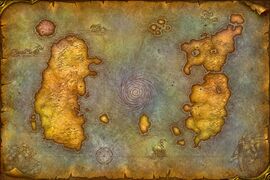
Patch 0.5.5 alpha
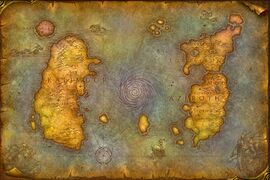
Classic intro cinematic
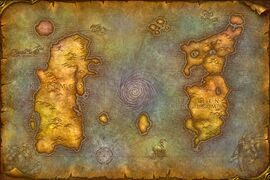
Classic release
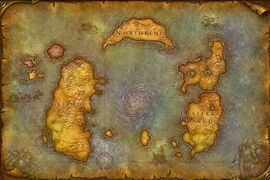
Wrath of the Lich King alpha
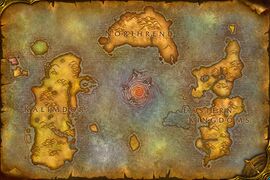
Cataclysm beta
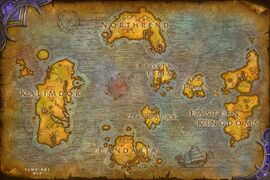
Battle for Azeroth alpha
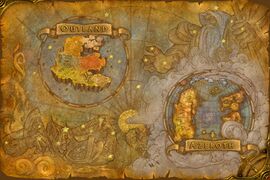
On the Cosmic map in patch 2.0.3
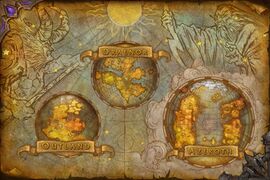
On the Cosmic map in patch 6.0.2
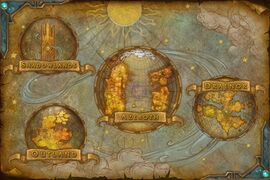
On the Cosmic map in patch 9.0.1
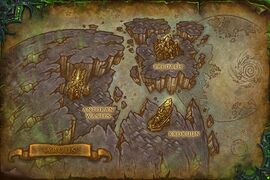
On the background of the Argus map in patch 7.3.0


In-game depictions
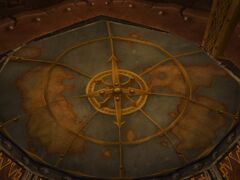
Map seen from a ceiling at the Hall of Explorers in Ironforge.
Map of Azeroth near a teleporter in Booty Bay, near the Salty Sailor Tavern.
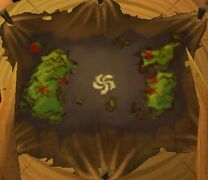
Azeroth map in the Hall of Legends in Orgrimmar.
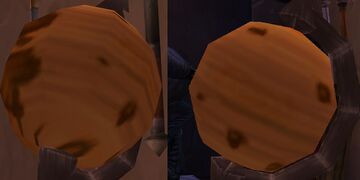
Globes depicting Azeroth.
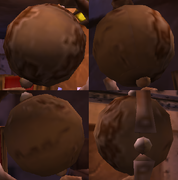
Simple globe.
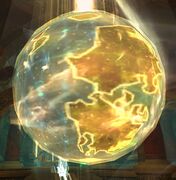
Kalimdor on a projected globe in the Halls of Lightning.
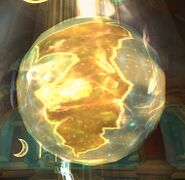
The Eastern Kingdoms on a projected globe in the Halls of Lightning.
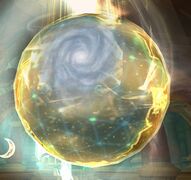
The Maelstrom on a projected globe in Halls of Lightning.

Azeroth's southern polar ice cap on a projected globe in the Halls of Lightning.
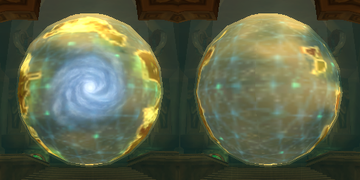
Azeroth's front and backside as seen in Halls of Lightning.

Azeroth globe.
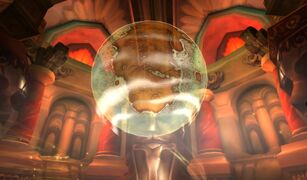
The vision of Azeroth in the Hall of Communion in Sholazar Basin.
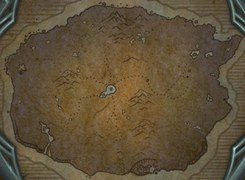
A map of ancient Kalimdor as seen in Black Rook Hold.
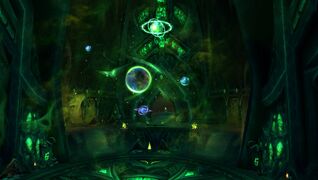
Azeroth can be seen in the Fel Hammer.
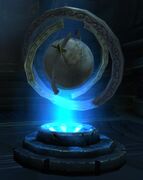
The Wounded World in the Chamber of Heart in the alpha and early beta of Battle for Azeroth.
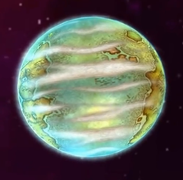
Azeroth's backside as seen in the quest A Legendary Engagement.
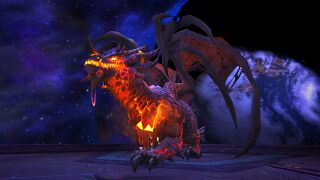
The planet behind Wrathion, the Black Emperor.


Chronicle
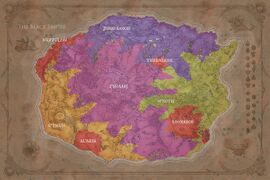
Kalimdor during the reign of the Black Empire.
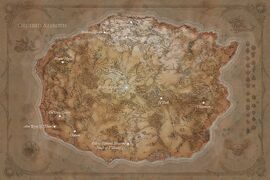
Ordered Kalimdor after the fall of the Black Empire.
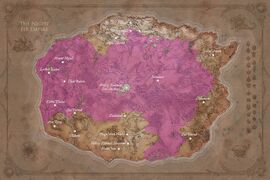
Kalimdor at the height of the night elven empire.
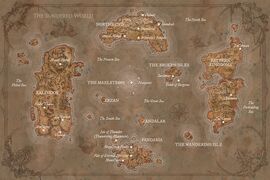
Azeroth after the Great Sundering.
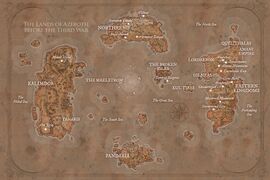
The lands of Azeroth before the Third War.
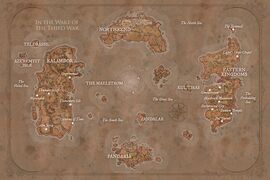
Azeroth at the time of Ahn'Qiraj's reopening.
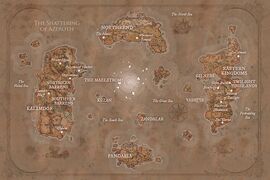
Azeroth after the Cataclysm.


Other
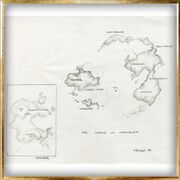
Early concept map.
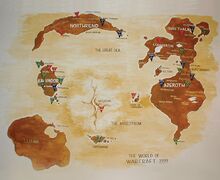
Early concept map as seen in the World of Warcraft Diary.
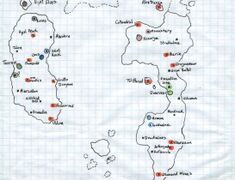
Early concept map as seen in the World of Warcraft Diary.
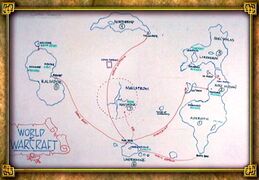
Very early concept map as seen in the World of Warcraft "Behind the Scenes" DVD.
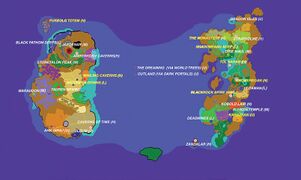
Concept from 2001.
![Original map plan for World of Warcraft from 2001 shown at BlizzCon 2007[20]](/images/thumb/7/7f/Original_Map_BlizzCon_2007.jpg/168px-Original_Map_BlizzCon_2007.jpg)
Original map plan for World of Warcraft from 2001 shown at BlizzCon 2007[20]
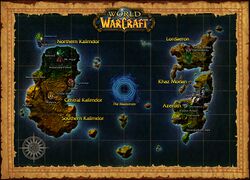
Pre-release map from the official World of Warcraft website
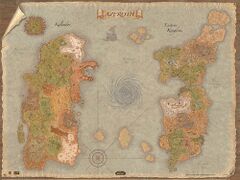
World of Warcraft World Map poster
Azeroth from the WoW logo in the 2004 "Sneak Peak" video
Azeroth from the WoW logo in the 2017 "Classic Announcement" video
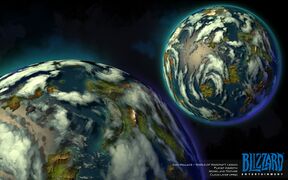
Azeroth art by Dan Wallace.
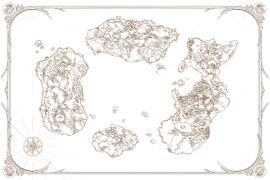
Azeroth transition era of the continents, unused art by Joseph Lacroix.


![Original map plan for World of Warcraft from 2001 shown at BlizzCon 2007[20]](/wiki/File:Original_Map_BlizzCon_2007.jpg)


- Warcraft III
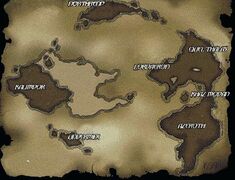
Warcraft III alpha
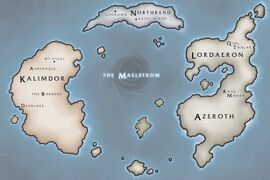
Warcraft III manual
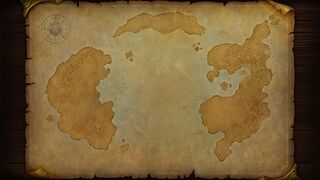
Loading screen in the Warcraft III: Reforged beta
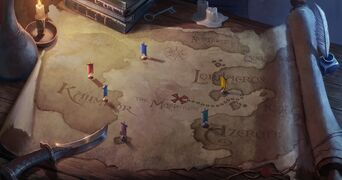
Warcraft III: Reforged default loading screen


- RPG
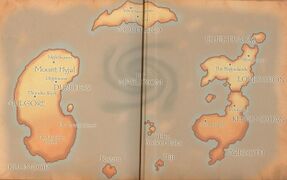
Warcraft RPG map
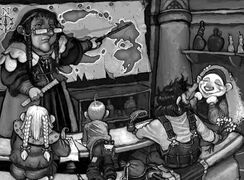
Lands of Conflict Explorer's Guild classroom map
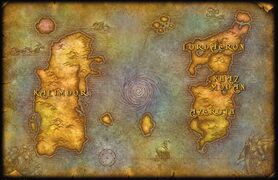
World of Warcraft: The Roleplaying Game used the then-current WoW map
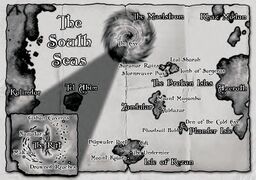
Lands of Mystery depicted the South Seas region of Azeroth


Fan art
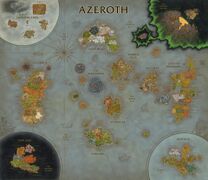
Fan-made composite map by Subthermal (patch 9.0.1)
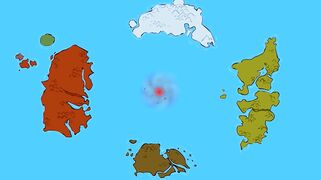
Azeroth in WowCraft, by Carbot Animations
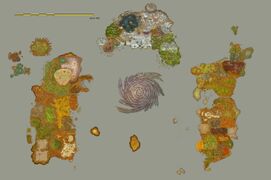
Regional maps and inaccessible areas composite map before Cataclysm
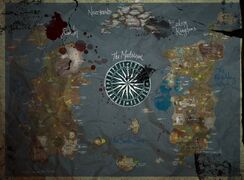
Map of Azeroth prior to the Cataclysm
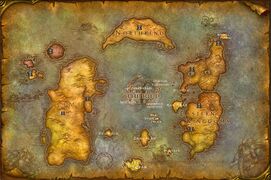
Fan-made composite map from existing source maps before WotLK
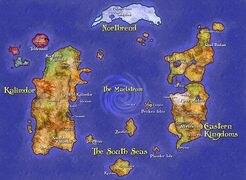
Fan-made map by Warlock


References
- ^ Blizzcon 2015: World and Content Overview Panel (around 41:30)
- ^ Mists of Pandaria Zone Preview: Kun-Lai Summit
- ^ Thrall: Twilight of the Aspects, chapter 2
- ^ a b c d e World of Warcraft: Chronicle Volume 1
- ^ Rhyolith#Adventure Guide
- ^ Ragnaros (Firelands tactics)#Adventure Guide
- ^
 [10-45] The Diamond King
- ^ Legion reveal
- ^

 [10] Mirror Lake
- ^ Traveler: The Shining Blade
- ^ 2017-11-07, BlizzCon 2017 World of Warcraft: Gameplay and Systems Panel Transcript. Blizzplanet, retrieved on 2017-11-15
- ^ Ny'alotha, the Waking City: The Corruptor's End#Notes
- ^ World of Warcraft: The Dragonflight Codex, pg. 122
- ^ a b Lands of Conflict, pg. 18
- ^ World of Warcraft: Chronicle Volume 1, pg. 29 - This burgeoning civilization was located near the center of Azeroth's largest continent.
- ^ World of Warcraft: Chronicle Volume 3, pg. 69 - Over ten thousand years ago, they built a glorious empire that reached the far corners of Azeroth's single landmass.
- ^ [10-45] Minion! Kill Them!
- ^ WoW: Herz von Azeroth: Wir bereuen viel - Interview mit Ion Hazzikostas. buffed (2019-04-04).
- ^ "Creative people draw from numerous wellsprings to water their own gardens. The name "Azeroth," the continent where Orcs and Human clashed in several WarCraft games, comes from the novel Fires of Azeroth by novelist C.J. Cherryh. Published in 1979, Fires of Azeroth is the third installment in The Morgaine Stories science fiction series that follows time-jumping heroine Morgaine. To escape certain death at the hands of a large army, Morgaine flees into the forests of the world of Azeroth." - Stay Awhile and Listen: How Two Blizzards Unleashed Diablo and Forged a Video-Game Empire
- ^ BlizzCon 2007 - Dungeons & Raids panel
| |||||||||||||||||||||||
| ||||||||||||||||||||||||||||||||||||||
es:Azeroth