Forest troll
| Forest trolls | |
|---|---|
|
| |
| Faction/Affiliation |
Various tribes, Amani Empire, Dark Horde, Horde, Zandalari Empire, Independent Formerly: Old Horde, Empire of Zul |
| Character classes |
|
| Racial capital |
|
| Racial leader(s) | See below |
| Homeworld | Azeroth |
| Language(s) |
Zandali, Orcish, Common |
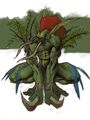
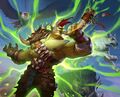
Forest trolls are a green-skinned subgroup of trolls found in the forests of Lordaeron. In modern times, the word Amani can refer to their ancient empire (and thus to forest trolls as a whole) or to the Amani tribe in particular.[2] They are one of the most ancient indigenous races of Lordaeron. Like other trolls, they worship the loa, practice voodoo, ritual sacrifices, and, in some cases, cannibalism. They are generally hostile, focusing on warfare, and have a particular hatred for the elves of Quel'Thalas, whom they consider the despoilers of their ancient homelands.[3] Though, in recent years, the Revantusk tribe has allied with the Horde.
History
In ancient times, the Amani were among the tribes that arose to challenge the Zandalari for territory and power. They laid claim to enormous swaths of land in Ancient Kalimdor's lush woods. On occasion, they clashed with other tribes, often over hunting grounds. Yet major conflicts were few and rarely lengthy. Trolls were such skilled and fierce fighters that any real conflict would cost both sides dearly. Untouched land was plentiful in all directions, and the various tribes quickly learned it was wiser to resettle than to risk war.[4]
Aqir and Troll War
Circa 16,000 BDP, during the Aqir and Troll War, the aqir encroached perilously close to the Zandalar, leading the Zandalari to unite the disparate troll tribes, including the Amani, into a single mighty force, the Empire of Zul. Together, they drove the aqir away, and at the Zandalari's behest, the other tribes moved out to hunt down the aqir across Ancient Kalimdor to permanently end the threat. The Zandalari also convinced the most power-hungry troll factions to establish new strongholds across Azeroth. The Amani set out to destroy Kith'ix, the C'Thrax general who had started the war. In a final savage battle, the entire tribe flung itself in a suicidal attack against Kith'ix and its remaining insectoid minions. Only a tiny fraction of the troll army survived. Atop the site where they had killed Kith'ix, the trolls established a new settlement, which would one day grow into a sprawling temple city and the capital of their empire, Zul'Aman.[5]
Troll Wars
Around 6,800 BDP, Highborne led by Dath'Remar Sunstrider, exiled from Kalimdor, entered Amani territory in the north of what would become the Eastern Kingdoms. Their presence enraged the Amani, who launched immediate raids. Using arcane might, the elves pushed through and established Quel'Thalas above the nexus of ley lines they had been seeking, atop sacred Amani ruins. Outnumbered by more than ten to one, the elves held off brutal Amani assaults by channeling power from a nexus of ley lines. Over time, the Amani were driven back to Zul'Aman, vowing vengeance.[6]
Centuries later, around 2,800 BDP, internal strife weakened the Amani until the Zandalari Empire intervened to restore their strength. They named the fierce warrior Jintha as chieftain and prepared for war, ensuring that the mighty loa demigods would aid them in battle. In a sudden campaign, the Amani surged out of the forests, devastating the borders of Quel'Thalas.[7]
High King Anasterian Sunstrider appealed to King Thoradin of Strom for aid, warning that the trolls would soon threaten all of Arathor. Jintha, confident in victory, turned south to crush the humans. After weeks of brutal and bloody fighting, the elves and humans unveiled a devastating weapon: the One Hundred, human magi trained in arcane arts. In a single terrible spell, torrents of fire lashed down from the sky, annihilating the Amani ranks. Jintha fell early in the assault, and without their leader, the trolls fled back to Zul'Aman. The Zandalari emissaries, disillusioned, withdrew.[8]
During the war, troll witch doctors tried to curse the elven runeblade Felo'melorn, but the weapon still slew hundreds of Amani and earned infamy as a troll-killer.[9][10][11]
After the Amani Empire was shattered by the Troll Wars, most forest trolls settled in areas that were a comfortable distance from Quel'Thalas. The Mossflayer tribe were driven out of much of their ancestral territory in Lordaeron by the humans. The Revantusk tribe was nearly wiped out by the Troll Wars, and reluctantly, they moved a safe distance away from the elven invaders. The Vilebranch tribe returned to their ancestral lands, in the area that is now called the Hinterlands. The Witherbark tribe did the same, returning to their lands in the Hinterlands and the Arathi Highlands. The Smolderthorn tribe and Firetree tribe also split away. However, the Amani tribe sneered at such precautions as cowardice. Beset by the high elves' powerful sorcery, Zul'Aman was greatly reduced in size, but the Amani tribe remained entrenched at the easternmost edge of the enchanted kingdom.[12]
First War
The forest troll tribes remained scattered for millennia, until the rise of the troll warlord, Zul'jin, some years before the start of the First War. Zul'jin was the first forest troll since the Troll Wars to reunite the tribes of Zul'Aman and beyond. One by one, he challenged the other tribe leaders and defeated them, whether in combat, at racing, or at some other task. And all bowed before him, pledging themselves and their tribes to his rule. The forest trolls were a single people once more. During the First War, Blackhand tried to recruit the forest trolls, but Zul'jin refused.[13]
Second War
At the start of the Second War in 5 ADP, the Amani trolls celebrated Stormwind's destruction by the Horde. Some pledged to join the Orcish Horde in exchange for Warchief Orgrim Doomhammer's aid. Zul'jin had been captured by humans and imprisoned in Durnholde Keep in the Hillsbrad Foothills.[14] In 6 ADP, as battles raged in Hillsbrad between orcs and the Alliance of Lordaeron, Doomhammer led a raid to free Zul'jin. Afterward, Doomhammer invited the Amani to join the Horde. Zul'jin hesitated, but Doomhammer assured him equality and promised that with the Horde's help, they would wipe the world clean of humans and elves alike. The trolls would rule the forests once more,[15] and avenge the Amani Empire.[16][12]
To win the war, Doomhammer ordered the Horde east through a narrow pass into the Hinterlands. The trolls guided the orcs over the northern mountains into Quel'Thalas. Zul'jin rallied local Amani trolls and gathered more troops from Zul'Aman. Thousands adorned with enchanted talismans and ritual tattoos joined Orgrim's forces. The army quickly devastated the kingdom's outer holdings. Many death knights and Amani witch doctors struggled to wield magic against the elven runestone barrier, Ban'dinoriel, erected when Quel'Thalas was founded. But orc warlock Gul'dan dismantled one runestone, breaking the shield.[17]
With their magic restored, the Horde spellcasters stormed toward Silvermoon City. They pillaged settlements and slaughtered elves. Silvermoon's shield, powered by the Sunwell, held firm against repeated attacks. Zul'jin and the Amani refused Doomhammer's order to turn west, vowing to destroy all of Quel'Thalas and bring King Anasterian's severed head before attacking Lordaeron. Losing the trolls could doom the Horde—until Gul'dan convinced Orgrim and Zul'jin that the Stormreaver clan had found a way to destroy the shield. Once broken, the elven city would fall, the trolls would avenge themselves, and then rejoin the Horde.[18]
However, Gul'dan planned to betray both. After Doomhammer marched to Lordaeron's capital, Gul'dan and his allies secretly pursued the Tomb of Sargeras. The Amani ignored his call and continued the siege.[19] Because of Gul'dan's treachery, the war shifted in the Alliance's favor. While the Alliance besieged Blackrock Spire, King Anasterian led efforts to expel the Amani from Quel'Thalas. Despite heavy losses, the elves prevailed. Most tribes under Zul'jin scattered again.[20][12]
Third War
When the plague of undeath began spreading across the land, the Mossflayer tribe was quick to take advantage of the blossoming chaos. Because the plague was designed to convert only the human race into undeath, human defenses soon faltered, and the Mossflayers managed to retake parts of their ancient territory.[12]
During the Third War in 21 ADP, as the death knight Arthas Menethil led the Scourge into Quel'Thalas, the Amani tribe witnessed the resulting slaughter with glee. Acting swiftly, the trolls launched a series of attacks on high elf settlements in the Eversong Forest. To the Amani's surprise, the few high elves who had survived seemed greatly weakened and put up a poor fight, which allowed them to claim a significant portion of the forest before the return of Prince Kael'thas Sunstrider. When the elven prince, the Magisters and their guards arrived at Quel'Danas to destroy the corrupted Sunwell, the Amani tribe also landed on the isle with their destroyers. When the mages destroyed the Sunwell, its blast caught everyone standing near it, troll and undead alike.[21]
Afterward, Kael'thas gathered the surviving elves and renamed them the blood elves. He then organized them into a fighting force that proved frustratingly effective against the Amani tribe's efforts, even after Kael'thas and his strongest warriors left Quel'Thalas to fight the Scourge elsewhere. Nevertheless, the Amani tribe remained fiercely dedicated to its battle against the elves, while the diminished elven populace continued fighting both the trolls to the east and the Scourge to the south.[22]
The Shadowglen tribe within Silverpine Forest were seemingly wiped out by Illidan Stormrage and the naga, as they sought to rescue Tyrande Whisperwind from the Scourge.[23]
During the Plaguelands civil war, a band of forest trolls led by Zul'rogg were caught in the crossfire as the forces of Sylvanas Windrunner clashed against those of the dreadlord Varimathras.[24]
World of Warcraft
In the aftermath of the Third War, both the Revantusk and Witherbark tribes aligned with the Horde. While the Revantusk maintained a pact of friendship and mutual assistance,[25] the Witherbark betrayed them, earning them the wrath of the Darkspear tribe.[26] The Firetree and Smolderthorn tribes, meanwhile, joined the Dark Horde under Dal'rend Blackhand.[12]
In time, the Boulderfist clan and the Witherbark tribe allied to wipe out Hammerfall.[27] However, Horde champions were directed to strike the ogres and trolls, leaving Drum Fel confident that Hammerfall would begin to thrive in the Arathi Highlands.[28]
In the Hinterlands, the Vilebranch tribe clashed with the Revantusk and captured one of the tribes' leaders, Elder Torntusk. Their leader, Vile Priestess Hexx, sought to sacrifice the elder to the faceless Blood God, Hakkar the Soulflayer.[29][30] The Revantusk called upon their Horde allies to strike back, which saw to the death of Vile Priestess Hexx, and the liberation of Elder Torntusk.[31]
In the Eastern Plaguelands, the Mossflayer tribe sent hunters from Zul'Mashar in search of live game; however, a lich had tainted the animals, and those who ate the meat became undead under his control. Most of the newly risen trolls established a base in the southwest, while Infiltrator Hameya was sent back to infect his people. Soon, Zul'Mashar was filled with fresh graves and undead trolls, though some Mossflayers still survived.[32]
In Year 25 ADP, Blackrock Spire came under attack by adventurers of the Horde and the Alliance, where a number of the Smolderthorn, including Shadow Hunter Vosh'gajin, were slain. Marshal Maxwell and Warlord Goretooth also ordered their champions to kill the Smolderthorn Chieftain, War Master Voone.[33][34]
When Hakkar returned in Zul'Gurub, the Witherbark and Vilebranch pledged their allegiance to Jin'do and their souls to Hakkar,[35] and sent ambassadors to Zul'Gurub.[36][37]
The Burning Crusade
Prior to the invasion of Outland, Lieutenant Dawnrunner of the Farstriders hired blood elf adventurers to deal with Amani encroachment in Eversong Woods. She had them slay Amani in Zeb'Watha and Tor'Watha.[38] Adventurers also found invasion plans indicating that the Amani had been aiming to attack Fairbreeze Village.[39]
In the Ghostlands, the Farstriders had adopted a policy of keeping the Shadowpine tribe off balance until the day when they could launch a brutal offensive to wipe them out. To that end Farstrider Solanna called for blood elf adventurers to strike at the Shadowpine within Zeb'Tela and Zeb'Nowa.[40][41]
Furthermore, the Farstriders discovered that the Shadowpine were raising the mummies in the Amani Catacombs to bolster their numbers, and called for the catacombs to be investigated, with any remains within to be burned to ash.[42] After the Shadowpine chieftain Kel'gash the Wicked was slain by adventurers seeking to collect the bounty on his head, the Shadowpine descended into total disarray.[43]
The Gods of Zul'Aman
During the invasion of Outland in 26 ADP, as the Horde and the Alliance were waging war on Illidan Stormrage's forces, Warlord Zul'jin and his Amani trolls prepared to march on Quel'Thalas. Zul'jin had been captured by the elves following the Amani defeat in the Second War, though he managed to escape, he lost an eye and an arm in the ordeal.[21]
Since then, he and the Amani had been waiting for the perfect opportunity to launch a new, full-out assault. With most of Quel'Thalas's soldiers occupied on Outland, that opportunity was at hand. The blood elves had recently joined the Horde, which had granted them more power and resources. Zul'jin believed Quel'Thalas would inevitably convince its new allies to strike at the Amani empire. Within the Amani capital, Zul'Aman, troll priests performed rituals to harness the power of their loa. Their energies suffused the troll soldiers, transforming them into living embodiments of the loa. The Horde was desperate not to fight a war on two fronts. The faction's mightiest champions volunteered to storm Zul'Aman. The Horde's strike force cut off the serpent's head, killing Zul'jin and his priests before their rampage in Quel'Thalas could even begin.[44]
Cataclysm
Following the Cataclysm, the Witherbark trolls were driven out of the Hinterlands by the Forsaken,[45] and those within the Arathi Highlands came under attack by the Horde.[46]
The Hinterlands themselves became drenched in war as the Revantusk, now official members of the Horde, fought to claim the region for themselves and the Horde. To that end, they drove out the Vilebranch tribe from Shaol'watha, which they subsequently claimed. From the ruins, General Gan'dranda led the Revantusk in their attack on Stormfeather Outpost.[47][48] In response, Kerr Ironsight directed Alliance champions with joining the battlefield,[49] and taking out Gan'dranda. Ironsight believed that the general's death would take the fight out of the Revantusk.[50]
The Vilebranch within Jintha'Alor came under attack from both the Alliance and Horde, with the Wildhammer clan wishing to stop the threat they represented, while the Revantusk sought to claim Jintha'Alor as their own. The Vilebranch were ultimately defeated, with Jintha'Alor claimed by the Revantusk.[51] The two factions then pressed their attack striking at the Vilebranch within Agol'watha, as they sought to summon Shadra, with the Wildhammer seeking to kill her in advance before she could be directed to them, while the Forsaken once more collected Shadra's venom for their apothecaries.[52]
After the Cataclysm in 28 ADP, the Smolderthorn were among the Dark Horde forces within the Pillar of Ash and Blackrock Stronghold based within the Burning Steppes that came under attack by Horde and Alliance forces.[53] War Master Voone was later targeted by Acride who sent adventurers to kill him.[54]
Rise of the Zandalari
To fill the power vacuum left by the death of Zul'jin, the remaining trolls chose their favored champion, Daakara the Invincible, to reclaim their lost glory.[55] Following the Cataclysm caused by Deathwing in 28 ADP, Prophet Zul of the Zandalari Empire saw an opportunity. The Zandalari could take advantage of the chaos to unite the scattered troll tribes into a mighty empire and establish themselves as Azeroth's preeminent power, like in ancient times. During a meeting in Stranglethorn Vale, Daakara and the Amani agreed to this path.[56] With the Zandalari's aid, Zul'Aman was rebuilt, and the Amani Empire replenished their forces for a bloody campaign to expand their territories.[57]
When Zul reached out to Vol'jin and his Darkspear trolls, the chieftain rejected the offer and moved to end the Zandalari's warmongering. Vol'jin joined forces with his Horde ally Ranger General Halduron Brightwing and his Farstriders and marched to nip the Amani empire in the bud. Overstretched, Halduron called upon Vereesa Windrunner and the Silver Covenant to assist their cause.[58] After deciding on an appropriate battle plan, Vol'jin personally led a strike force into Zul'Aman, and with the aid of adventurers, he put an end to Daakara and the Zandalari's efforts within Zul'Aman.[59]
Mists of Pandaria
As the Alliance and Horde were exploring the continent of Pandaria in 30 ADP, word of its rediscovery reached the Zandalari trolls as well. By the hundreds, these Zandalari boarded ships and set sail to conquer the long-lost continent. The Amani bolstered the Zandalari Invaders along with the Gurubashi, Drakkari, and Farraki tribes.[60]
After the Zandalari managed to revive their ancient ally, Lei Shen, the Thunder King, the Amani'shi convened with the other troll tribes and the mogu on the Isle of Thunder. There, they faced the combined forces of the Alliance and Horde, who eventually managed to raid the Throne of Thunder, Lei Shen's seat of power. In the end, while they fought fiercely, the Amani and their leader Kazra'jin were defeated.[61][62]
Legion
By the time of the Legion's third invasion in 32 ADP, Stromgarde was taken by Galen Trollbane, and the Witherbarks led by Ojin'ba attacked the city and holed up in the mage district. The death knights of the Ebon Blade killed them following a deal between them and Galen.[63]
Fourth War and aftermath
During the Fourth War in 33 ADP, speakers from all forest troll tribes were present at the Terrace of the Speakers in Dazar'alor. While the Revantusk declared their friendship to the Horde,[64] the other tribes were more disdainful, with the Amani within their enclave of Tal'aman, in the Port of Zandalar of Zuldazar, outright resisting the idea of the Horde allying with the Zandalari Empire.
After Princess Talanji opened the port to all races to peddle their wares, the merchants found themselves shaken down by Amani thugs, among other tribes.[65] As punishment, Zolani, the Blade of the King, tasked Horde adventurers with slaying the ruffians and collecting Amani heads in Tal'Aman,[66] while Spymistress Yazma had them go after their loa disciples.[67] The adventurers also defeated the Amani champion Kul'krazahn.[68]
By the time of the Battle for Stromgarde, the Witherbark trolls sent regular attacks against both the Alliance and Horde and became the target of both factions, who wished to see them disappear.[69] Among them, Nimar the Slayer was a priority target, for his dangerousness,[70] taking many fighters with him in death.[71] Their alliance with the Boulderfist clan appears to have fallen apart, as members of their tribe can be found in the ogre den's cages.
When Master Gadrin sought to have Vol'jin's ashes be placed in Atal'Dazar, Amani trolls were among the challengers who tried to stop him.[72]
Following the death of God King Rastakhan in the Battle of Dazar'alor, the forest troll tribes took part in the funeral procession.[73]
A few years later, in 42 ADP, First Arcanist Thalyssra noted in her travel journal that the Amani enclave of Tal'aman in Dazar'alor was more peaceful and that the Amani had ceased harassing merchants. Despite their history of hostility with the Horde, the Amani trolls gave her no trouble.[74]
The War Within
After the machinations of the Red Dawn, the Witherbark tribe took to attacking human settlements within the Arathi Highlands and clashed with the Mag'har. At the same time, Syndicate agents were instructed to attack the Witherbark and plant evidence that the Horde was responsible. However, these agents were captured and subsequently tortured by the Witherbark. Overlord Geya'rah ultimately gave the order to liberate the Syndicate prisoners and to have the Witherbark bloodied. In the aftermath, Geya'rah was convinced that they would be cowed and not stray from their village for some time.[75][76]
Midnight
| This section is a lore stub. |
By the time of Xal'atath's invasion of Quel'Thalas and Zul'Aman, the Amani were led by Zul'jarra, the granddaughter of Warlord Zul'jin, and had lost touch with the loa. With Zul'jan serving as her adviser, Zul'jarra seeks a way to help her people survive the oncoming void onslaught.[77] Adventurers will entreat with her.[78]
Meanwhile, the Witherbark will be present in the Maisara Caverns dungeon, where they have been abducted by the Vilebranch tribe.
Biology
Forest trolls are leaner, more agile, and taller than orcs,[79] but still significantly smaller than the tallest of trolls, the Zandalari and Drakkari.[80]
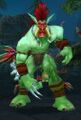
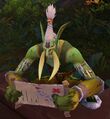
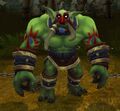
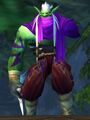
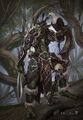
Like other trolls, forest trolls have long beak-like noses and pointed chins. They have tusks, typically coming from their lower lip; these tusks can vary between a foot long and barely visible. Forest trolls are fairly strong but are also extremely agile. The third toe on their feet helps forest trolls to maintain balance and climb trees.
Due to a mutation that took place many millennia ago, the forest trolls' bodies can support plant life to a limited extent, considered by some to be a strong affinity for plant life. A thin layer of moss inevitably grows on the skin of forest trolls shortly after they are born and gives them their characteristic green coloring.[81][82] Their bodies could also support other simple forms of vegetation, such as algae.[83]
Orgrim Doomhammer compared forest trolls to ogres when he first saw them. After finding out that they were agile, cunning, and smart, he eventually concluded that the trolls were more similar to orcs despite their ogre-like size and strength.[84]
Some forest trolls have long, taloned fingers that are perfect for digging through rock and earth.[85]
Culture
Like their brethren, forest trolls have developed a wide array of superstitious customs. They devote themselves to warfare, practice ritual sacrifices and, in some cases, cannibalism.[3][86]
Warfare
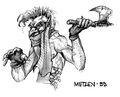
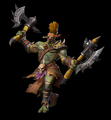
Trolls have become quite adept at fashioning a special sort of throwing axe using ironwood. The crafting and use of this weapon is always being honed to perfection. Forest troll axethrowers employ these weapons—along with a cunning attack and retreat stratagem—to assail their foes. This combination of speed, range, and the ability to bring down threats from above makes them dangerous foes.[87]
Berserkers are a bloodthirsty sect of trolls dedicated to the total annihilation of their hated enemies. Suffering numerous experiments with strange chemicals and potions, the Berserkers are hardier and stronger than most trolls and have had many abilities bestowed upon them, such as sharper sight and enhanced regeneration that make them all but unstoppable in the heat of battle.[87]
During the Second War, forest trolls were a vital part of the Horde's lumber processing operation. Living in forests, they have devised a unique method of harvesting. By treating a group of trees with a volatile alchemical solvent, they can deaden and weaken large sections of wood. Though it is extremely hazardous, this site makes the process of cutting lumber more efficient.[87]
Forest trolls also provided the Horde with Troll Destroyers. Swift, ill-visaged longboats designed to cut through enemy armadas and deal damage to enemy vessels and their flying support. They were equipped with cannons[88] and designed to stand mast to mast against the Elven Destroyers.[87]
Magic
Forest trolls hone their ties to a dark and powerful form of magic known as voodoo[86] as well as shamanism and priest magics. Arcane magic seems to be unpopular, as Huntsman Markhor of the Revantusk has stated they dislike how other races abuse it.[89]
Shadowpine priests tried to bolster their numbers through necromantic means, as they were raising mummies.[90] On top of that, the forest trolls possess ways to speak with the dead that even other trolls aren't capable of.[91]
The Vilebranch and Witherbark count warlocks among their ranks.[92][93] Furthermore, the Vilebranch hang tiki masks on their walls, through which their spirits watch over them and protect them with wards and hexes created with heretical dark voodoo.[94]
Faith
Forest trolls worship a pantheon of loa, which consists of Akil'zon, Nalorakk, Jan'alai, and Halazzi. There is also Akil'darah, the eagle spirit of the Hinterlands.[95]
Several tribes of forest trolls worshiped Hakkar the Soulflayer,[96] they even sent speakers to the Gurubashi tribe when they successfully resurrected the blood god,[97] however after his defeat, they seemingly abandoned the worship of Hakkar. Instead, they shifted their focus to another loa, Shadra.[98]
There are also signs of Hir'eek[99] and Zanza the Restless[100] being worshiped by forest trolls in the past; however, there is no known member of their race who worships them now.
Forest trolls erect large slabs of stone adorned with ceremonial masks along their border as warnings and border marks. The border marks also act as shrines, and offerings are placed at them and at times even the skulls of the trolls' enemies.[101]
Bestiary
Longtime allies of all trolls, raptors form a special bond with their masters. They become steed, guardian, and friend.[102]
The Amani trolls decorate their ferocious battle bear mounts in magic amulets and ceremonial masks as a way to venerate the bear god Nalorakk.[103] They also ride these fierce creatures on ceremonial hunts in honor of the bear god.[104]
Amani trolls hold dragonhawks in high regard due to the loa Jan'alai, who shares their appearance.[105]
Vampire bats have been trained as scouts and mounts by the Amani.[106] The Witherbark also raise giant bats, which they brought to the Arathi Highlands with them.[107]
The Amani trolls have been known to tame eagles.[108][109] The tortured and cruelly warped Dark Eagle was used by the troll army to fight the Farstriders.[110]
Amani and Shadowpine trolls have lynx companions.[111][112] The Amani have also tamed crocolisks[113] and snakes.[114]
Forest trolls have been known to use tamed wolves to protect their settlements.[115][116][117]
The Shadowglen Trolls used giant sea turtles in combat.[118]
The forest trolls of the Hinterlands tame spiders, some of whom are descendants of Shadra herself.[119][120][121]
Relations
Forest trolls are vicious and cunning. As cannibals, they eat the flesh of their enemies and even sometimes each other. Forest trolls have few allies; they hate orcs, who they see as weak and who failed in their promise to return the forest trolls to their former glory. Many tribes of forest trolls are also hostile towards each other. The Revantusk tribe is the only tribe friendly towards the Horde.[12]
Forest trolls and high elves see each other as sworn enemies. The trolls hate the elves, as they invaded their lands and almost wiped them out, and the elves see the forest trolls as barbarians intent on destroying their homeland.[3] That is with the exception of the Revantusk tribe, who, because of their association with the Horde, are more willing to work with its elven members.[122] Instead, their hatred seems to be shifted towards their neighboring tribes, whom they see as depraved cannibals,[123] and dwarves who invaded the Hinterlands and encroached on their lands.[124][125]
Tribes
| Name | Description | Leader(s) | Territories | Affiliation | Status |
|---|---|---|---|---|---|
| Historically, the leading forest tribe and namesake of the Amani Empire. | Zul'Aman • Tor'Watha • Zeb'Watha • Tal'aman |
Amani Empire | Active | ||
| One of two tribes of forest trolls that are part of the Dark Horde. | Unknown | Unknown | Dark Horde | Active | |
| An Eastern Plaguelands tribe. Many of its members have been converted into undead. | Zul'Mashar | Independent | Active | ||
| A Hinterlands tribe. Has a pact of friendship and mutual assistance with the Horde. | Revantusk Village • Jintha'Alor • Shaol'watha • Skulk Rock |
Horde | Active | ||
| Nomadic tribe that mainly worships Jan'alai. | Temple of Jan'alai • Zeb'Nowa • Zeb'Sora • Zeb'Tela |
Amani Empire | Active | ||
| One of two tribes of forest trolls that are part of the Dark Horde. | Tazz'Alor | Dark Horde | Active | ||
| A Hinterlands tribe. Foul cannibals and worshipers of Hakkar the Soulflayer. | Jintha'alor • Agol'watha • Altar of Zul • Shadra'Alor • Shaol'watha |
Independent | Active | ||
| An Arathi Highlands tribe and the sworn enemies of Stromgarde. | Witherbark Village • Creeping Ruin • Hiri'watha • Shadra'Alor • Zun'watha |
Independent | Active | ||
| Shadowglen tribe | A Silverpine Forest tribe wiped out by Illidan and his naga during the Third War. | Unknown | Unknown | Destroyed | |
| Blackleaf tribe |
A tribe that lives in Zul'Aman. | Unknown | Unknown | Unknown | Unknown |
| Treeblight tribe |
A tribe that lives in Zul'Aman. | Unknown | Unknown | Unknown | Unknown |
Notable
Note: For the last known active tribe leaders, see above.
| Name | Role(s) | Affiliation(s) | Location | Status |
|---|---|---|---|---|
| Warlord of Zul'Aman and chieftain of the Amani tribe. | Amani tribe | Zul'Aman | Deceased | |
| Champion and leader of the Amani. Known as the Invincible. | Amani tribe | Zul'Aman | Deceased | |
| Among the most feared witch doctors of the Amani tribe. | Amani tribe | Zul'Aman | Killable | |
| Amani shaman with a talent for the element of air. He became the Avatar of Akil'zon. | Amani tribe | Zul'Aman | Killable | |
| Amani renowned for his fearsome rage and savage strength. He became the Avatar of Nalorakk. | Amani tribe | Zul'Aman | Killable | |
| Highly skilled Amani rogue who became the Avatar of Jan'alai. | Amani tribe | Zul'Aman | Killable | |
| One of the greatest hunters of the Amani who became the Avatar of Halazzi. | Amani tribe | Zul'Aman | Killable | |
| Amani representative in the Council of Elders. | Amani tribe | Throne of Thunder | Deceased | |
| Amani champion in Tal'aman. | Amani tribe | Tal'aman, Zuldazar | Killable | |
| Leader of the Eversong Woods forest trolls. | Amani tribe | Zeb'Watha, Eversong Woods | Killable | |
| Former leader of the Mossflayer tribe. | Mossflayer tribe | Eastern Plaguelands | Active | |
| Undead who infected his tribe with the plague of undeath. | Scourge | Zul'Mashar, Eastern Plaguelands | Deceased | |
| A master of the shadow hunter arts. | Smolderthorn tribe | Tazz'Alor, Lower Blackrock Spire | Killable | |
| One of the leaders of the Witherbark within the Hinterlands. | Witherbark tribe | Hinterlands | Deceased | |
| Master huntsman of Revantusk Village. | Revantusk tribe | Revantusk Village, Hinterlands | Alive | |
| General of the Revantusk tribe. | Revantusk tribe | Shaol'watha, Hinterlands | Killable | |
| High priestess of Shadra. | Vilebranch tribe | Altar of Zul, Hinterlands | Killable | |
| Ruler of the Amani Empire during the Troll Wars | Amani tribe | Unknown | Deceased | |
| Amani ruler who used a powerful magical claw to enforce his rule. | Amani tribe | Unknown | Deceased | |
| Chieftain encountered by Sylvanas' Forces. | Unknown | Tirisfal Glades | Unknown | |
| Leader of an unnamed tribe of underground forest trolls. | Old Horde | Khaz Modan | Deceased | |
| Warlord of Zul'Aman in the RPG. | Amani tribe | Zul'Aman | Unknown |
In the RTS
Warcraft II
Forest trolls are one of the three races allied to the Horde, alongside ogres and goblins. They serve as counterparts to the high elven units: the Troll Axethrower for the Elven Archer, the Troll Berserker for the Elven Ranger, the Troll Destroyer for the Elven Destroyer and the Troll Lumber Mill for the Elven Lumber Mill.
| Name | Hit points | Armor | Sight | Speed | Basic Damage | Piercing Damage | Range | |
|---|---|---|---|---|---|---|---|---|
| Troll Axethrower | 40 | 0 | 5 | 10 | 3 | 6 - 8 | 4 | |
| Troll Berserker | 50 | 0 | 6 - 9 | 10 | 3 | 6 - 8 | 4 - 5 | |
| Troll Destroyer | 100 | 10 - 20 | 8 | 10 | 35 | 0 - 10 | 4 | |
| Zuljin | 40 | 0 | 6 | 10 | 3 | 6 - 8 | 5 | |
Warcraft III
Forest trolls are creeps that can be encountered in the Lordaeron Fall, Summer, and Winter, as well as the Village and Village Fall tilesets. In the campaign, during the Brothers Stormrage mission, the Shadowglen tribe of forest trolls appears, consisting of berserkers, healers, dark healers, dark priests, high priests, and their leader Krag'jin. Furthermore, during the Dark Lady, another forest troll chieftain, Zul'rogg, can be found in the Plaguelands.
| Unit name | Level | Hit Points | Mana | Armor | Attack | Range | Abilities | |
|---|---|---|---|---|---|---|---|---|
| Forest Troll | 2 | 300 | - | 0 (Heavy) | 17-20 (Pierce) | 50 | - | |
| Forest Troll Shadow Priest | 2 | 240 | 200 | 0 (Heavy) | 17-24 (Pierce) | 60 | Heal Abolish Magic | |
| Forest Troll Trapper | 3 | 400 | - | 1 (Medium) | 21-25 (Pierce) | 50 | Ensnare | |
| Forest Troll Berserker | 4 | 450 | - | 1 (Medium) | 28-37 (Pierce) | 50 | - | |
| Forest Troll High Priest | 4 | 450 | 300 | 0 (Medium) | 17-21 (Pierce) | 60 | Heal Abolish Magic Inner Fire | |
| Forest Troll Warlord | 6 | 750 | - | 0 (Heavy) | 36-43 (Pierce) | 50 | Trueshot Aura | |
In the RPG
- See also: Zul'Aman#In the RPG
As their name suggests, these trolls are found in forests. Forest troll culture is tribal and as primitive as their dark troll cousins. Though not as violent as dark trolls, forest trolls nonetheless have a fearsome reputation in battle.[126] In contrast to their wily jungle troll cousins, forest trolls are savage and unrelenting creatures. Not only are they cannibals like other trolls, but forest trolls also live for slaughtering lesser races, especially the high elves, whom they despise. Forest trolls believe that they are superior to every other race on Azeroth, prone to quoting just how powerful their former empire was.[127]
Like all trolls, forest trolls organize into tribes. A single chieftain rules each tribe. Each village also has at least one priest or witch doctor, who acts as a spiritual advisor for the chieftain and a healer for wounds trolls cannot heal themselves. Occasionally, this priest or witch doctor is the chieftain of the village, ruling with the voices of the voodoo spirits.[128]
Biology
Forest trolls resemble their jungle troll cousins but are taller and more muscled. Though in comparison to orcs, forest trolls are noted to be more lithe and agile. Their hair ranges from blood red to midnight black, while their skin is a deep olive green. Forest trolls decorate their bodies with ritual scarring and piercings, and they prefer white or dark warpaints symbolizing their power and glory. Like other trolls, they have an incredible regenerating ability and night vision.[127]
These humanoids are easily seven feet tall, with an impressive build and mottled, dark green skin covered with moss. Yellow teeth show under a large, hooked nose.[126] Female forest trolls are usually a couple of inches shorter than males on average.[127]
Forest trolls reach adulthood at around 17 years of age. They are considered middle-aged at 30 years, old at 47 years, and venerable at 69 years old.[127]
Relations
Forest trolls hold all other races in contempt—especially high elves, whom they consider the despoilers of their ancient homeland. They will only work with others if it means the elimination of an even more hated enemy. They allied with the Horde during the Second War in this manner, abandoning the orcs after their defeat.[127]
Cunning and vicious as the forest trolls are, few creatures would willingly associate with them. Most forest trolls hate orcs with a passion, believing them weak and pathetic. They also like to remind the orcs that they failed to restore Zul'Aman to its former glory, and they hold grudges. Humans and other members of the Alliance also earn the hatred of the race for protecting and supporting high elves.[128]
Most forest troll tribes keep to their own agendas, but the Revantusk tribe is now loosely allied with the Horde; members of other tribes hate the Horde for failing to fulfill its promise to restore the Amani Empire. While not members of the Horde, they are its friends. They know compassion, though they find it a bit difficult to relate to the Darkspear jungle trolls. Revantusk forest trolls still carry a racial hatred of elves and are ever ready to attack the Alliance. They view humans and other Alliance races as elf sympathizers and gleefully destroy them.[127]
Like all trolls, most forest trolls are savage and violent. While the Revantusks learn restraint and even camaraderie, they haven't entirely thrown off their old ways. Forest trolls of all types war with anything in range of their territory, even other tribes of forest trolls, and thus the Revantusks feel no remorse over slaying their wild brothers. The Revantusks have learned to accept other races and even trust certain individuals. Among the Horde, only the tauren truly respect the Revantusk tribe. Even their jungle troll cousins cannot bring themselves to accept their vile cousins yet.[127]
Faith and magic
Forest trolls practice voodoo witch doctor magic, though priests and shamans are becoming common as well. Shaman forest trolls perform voodoo dances and create effigies, and their priests almost uniformly worship Loa, or the godlike dark spirits of their faith. [128] Troll magic-users prefer divine magic. Troll healers almost always follow the path of the witch doctor, supporting troops with powerful elixirs, potions, and totems. Many troll witch doctors and priests become shadow hunters, stealthy warriors blessed with the dark powers of the Loa.[129]
Most Revantusk forest trolls follow the precepts of voodoo. While less prone to magic than other subraces, forest trolls still practice alchemical arts and worship dark voodoo spirits. Some forest trolls also worship Hakkar the Soulflayer, though jungle trolls outnumber forest trolls in this demography.[127] Many Revantusks have become more spiritual, learning divine magic that used to evade even the best of the race.[128]
Warfare
Forest troll society is focused solely on war. Even the youngest trolls are taught how to throw an axe with frightening accuracy, and more than a few are lectured in cruelty before they can even speak. They guard their territory with rabid ferocity. However, unlike other trolls, they go to war with other forest tribes as well. Each tribe wars with its neighbors, whether they're human, dwarf, or troll.[128]
Most trolls learn how to fight with thrown weapons from an early age, until all forest trolls are deadly ranged warriors. Unlike their jungle troll cousins, forest trolls favor axes, particularly handaxes. While quick and agile, they prefer brute force. The axe is a symbol of bloodthirsty power, of cleaving through anything before you.[128]
In battle, a forest troll throws himself furiously into the thick. Everything about the forest troll speaks of savagery and undisciplined battle, even during peaceful times. Like the Darkspears, the Revantusk tribe is atypical and is well-disciplined and even occasionally merciful in battle.[127]
Like their kin, forest trolls are primarily ranged support, naturally proficient and deadly with all manner of thrown weaponry. They favor stealthy attacks, perhaps with envenomed or cursed missiles, and practice guerrilla tactics. While trolls are about as prone to rages as orcs, trolls are more likely to set cunning traps, tricking foes into lowering their guards. Trolls also fight from the air. These rare trolls tamed the volatile vampire bats of Zul'Aman, convincing the bloodthirsty beasts to bear them into combat. Most troll batriders are insane, willing to ride to battle bearing explosive elixirs simply to cause chaos.[129]
Names
Forest trolls follow the same naming conventions as jungle trolls, though some of the suffixes and prefixes differ.
- Male Names: Doth, Mag, Ran, Vis.
- Female Names: Lith, Arn, Din, Mak.
- Family Names: Like jungle trolls, forest trolls have no family names.[127]
Notes and trivia
- In Day of the Dragon, Vereesa Windrunner and Falstad Wildhammer encountered an unnamed tribe of underground forest trolls led by Gree.
- The lore is conflicting on whether forest trolls like water or not. In the Warcraft RTS games and a few locations in World of Warcraft, the forest trolls are shown to have battleships such as destroyers with experienced crewmen. However, Alleria in the Tides of Darkness claims that trolls hate water and avoid being near it whenever they can.[130]Trolls have ships again in Blood of the Highborne and in Chronicle Volume 2.
- Forest trolls are often depicted with red hair, a nod to their iconic appearance in Warcraft II, but that color was actually that of the Blackrock clan in that game. The only time neutral forest trolls appeared in the campaigns, they were actually depicted in black.[131]
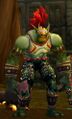
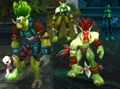
- After patch 2.3.0, most male forest trolls except for Qeeju were updated to a new model that made them more muscular.
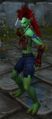
- Two skin colors on the patch 2.3.0 model have the hands and feet that are blue colored different than the rest of the skin that's green.
- It may be because the body is covered with moss and the hands and feet are uncovered, or because the hands and feet are covered with moss while the body is moss-free.
- Up until the Midnight expansion, female forest trolls used a green coloration of the main troll model. A 'buff' female forest troll model was added in Midnight and use the animations of a female orc. Male models were also updated to be higher resolution.
- Forest trolls were made playable in the Midnight expansion, as a customization option for the standard troll. As a result, their unique 'buff' model is unavailable to players.
- Two skin colors on the patch 2.3.0 model have the hands and feet that are blue colored different than the rest of the skin that's green.
- It was rumored that exiles from the Amani Empire journeyed to the Well of Eternity and were transformed into the first night elves, according to
[The Twin Empires]. However, according to World of Warcraft: Chronicle Volume 1, it was the dark trolls. - In Warcraft II: Beyond the Dark Portal, many forest trolls were brought by the Bleeding Hollow clan to Draenor and were divided among the clans of Draenor. Later lore such as World of Warcraft: The Burning Crusade and the Beyond the Dark Portal novel make no mention of forest trolls being in the Horde of Draenor, but it hasn't officially been stated if there's a retcon or if they simply weren't mentioned.
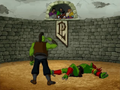
- In the canceled Warcraft Adventures, the original introduction cinematic showed Thrall fighting against an enslaved forest troll in the arena of Durnholde Keep before his escape. The troll's appearance was directly based off of the Troll Axethrower model in Warcraft II.
- When asked about the possibility of playable forest trolls, Paul Kubit (the associate game director of World of Warcraft: Midnight) said that they never wanted to close the doors on future opportunities.[132]
Speculation
This article or section includes speculation, observations or opinions possibly supported by lore or by Blizzard officials. It should not be taken as representing official lore.
|
- According to Omacron, a.k.a. "LordBecmiThaco" on Reddit, for the visual design of Warcraft's trolls, Chris Metzen may have been inspired by the character Tam Tam from Samurai Shodown, a game that was popular among Blizzard's developers.[133]
Gallery
- World of Warcraft
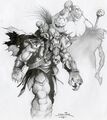
- Forest troll from the original Zul'Aman loading screen before the revamp in patch 4.1.0.
- In-game forest troll model from patch 2.3.0.
- Dire forest trolls use the same model as most other dire trolls.
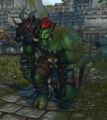
- Smolderthorn Lancer with a blue skin color.
- Firetree Witchdoctor with a blue skin color.
- Troll axethrower unit portrait, note the lack of tusks.
- Troll berserker unit portrait with tusks, from a transformed axethrower.
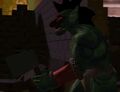
- Manual art of a troll axethrower.
- Manual art of a troll berserker.
- Other
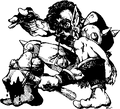
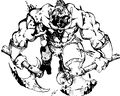
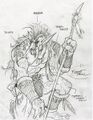
- A forest troll in the Manual of Monsters.
References
- ^ Kindling Aplenty
- ^ Troll Compendium/Forest Trolls
- ^ a b c Warcraft III: Reign of Chaos Game Manual#Trolls, Forest
- ^ World of Warcraft: Chronicle Volume 1, pg. 133 - 138
- ^ World of Warcraft: Chronicle Volume 1, pg. 138-142
- ^ World of Warcraft: Chronicle Volume 1, pg. 235 - 237
- ^ World of Warcraft: Chronicle Volume 1, pg. 253 - 254
- ^ World of Warcraft: Chronicle Volume 1, pg. 255 - 258
- ^ Archive of the Tirisgarde#Felo'melorn
- ^ Examiner Andoren Dawnrise
- ^ Blood of the Highborne
- ^ a b c d e f Troll Compendium/Forest Troll Tribes
- ^ Tides of Darkness, chapter 4
- ^ World of Warcraft: Chronicle Volume 2, pg. 146
- ^ Tides of Darkness, chapter 13
- ^ Ultimate Visual Guide, pg. 140
- ^ World of Warcraft: Chronicle Volume 2, pg. 162 - 163
- ^ World of Warcraft: Chronicle Volume 2, pg. 164 - 165
- ^ World of Warcraft: Chronicle Volume 2, pg. 168
- ^ World of Warcraft: Chronicle Volume 2, pg. 173
- ^ a b Blood of the Highborne
- ^ Troll Compendium: Amani tribe
- ^ The Brothers Stormrage (WC3 NightElf)
- ^ The Dark Lady (WC3 Undead)
- ^ Troll Compendium: Revantusk Tribe
- ^
[42] Grim Message
- ^ Troll Compendium: Witherbark Tribe
- ^
[40] Call to Arms
- ^
[51] Kidnapped Elder Torntusk!
- ^
[51] Job Opening: Guard Captain of Revantusk Village
- ^
[51] Return to Primal Torntusk
- ^ Troll Compendium: Mossflayer Tribe
- ^
[60D] Warlord's Command
- ^
[60D] Maxwell's Mission
- ^ Exzhal#Quotes
- ^ Witherbark Speaker
- ^ Vilebranch Speaker
- ^
[1-30] Amani Encroachment
- ^
[1-30] Amani Invasion
- ^
[1-30] Attack on Zeb'Tela
- ^
[1-30] Assault on Zeb'Nowa
- ^
[1-30] Investigate the Amani Catacombs
- ^
[1-30] Bring Me Kel'gash's Head!
- ^ World of Warcraft: Chronicle Volume 3, pg. 158
- ^
[50WQ] Wiping Out the Witherbark
- ^
[10-30] Crush the Witherbark
- ^
[10-30] The Savage Dwarves
- ^
[10-30] Out to the Front
- ^
[10-30] The Wicked Revantusk
- ^
[10-30] Gan'dranda
- ^
[10-30] It's Ours Now
- ^
[10-30] The Eye of Shadra
- ^
[15-30] Chiselgrip, the Heart of the Steppes
- ^
[20-30D] Trolls, Ogres, and Orcs, Oh My!
- ^ Daakara#Adventure Guide
- ^ World of Warcraft: Chronicle Volume 3, pg. 209
- ^ Patch 4.1.0 Content Preview: Rise of the Zandalari
- ^ Vol'jin#Meeting with Halduron and Vereesa
- ^ Vol'jin#Zul'Aman
- ^
[20-35] Enemies At Our Door
- ^ Council of Elders#Adventure Guide
- ^ World of Warcraft: Chronicle Volume 4, pg. 38
- ^
[10-45] Our Oldest Enemies
- ^ Revantusk Speaker
- ^
[10-60] Shakedown
- ^
[10-60] Deterrent
- ^
[10-60] Punishment of Tal'aman
- ^
[50RWQ] Kul'krazahn
- ^
[50] Wiping Out the Witherbark
- ^
[50RWQ] Nimar the Slayer
- ^ World of Warcraft: Exploring Azeroth: The Eastern Kingdoms, pg. 66
- ^
[50] Vol'jin, Son of Sen'jin
- ^
[60] The King's Death
- ^ Exploring Azeroth: Islands and Isles, pg. 58
- ^
[80] Withering the Witherbark
- ^
[80] Crime Family
- ^ World of Midnight Developer Panel | gamescom 2025 | World of Warcraft
- ^ World of Warcraft: Midnight#Zones
- ^ Tides of Darkness, chapter 4: "The one time [Doomhammer] had encountered forest trolls he had been impressed and a little disquieted by their cunning. Though the trolls were taller than orcs they were leaner and more agile[...]"
- ^ Troll Compendium/Other Trolls
- ^ Troll Compendium/Forest Trolls
- ^ Sean Copeland on Twitter
- ^
[Skull-Shaped Planter]
- ^ Tides of Darkness, chapter 4
- ^ Day of the Dragon, chapter 15
- ^ a b World of Warcraft: Chronicle Volume 1, pg. 133
- ^ a b c d Warcraft II: Tides of Darkness manual
- ^ The Fall of the Sunwell#He Who Walks the Day
- ^
[33D] The Right Way
- ^
[1-30] Troll Juju
- ^
[45] The Wild Gods
- ^ Vilebranch Shadowcaster
- ^ Witherbark Caller
- ^
[10-30] Faces of Evil
- ^ Kotonga#Quotes
- ^
[51] Kidnapped Elder Torntusk!
- ^ Exzhal Dialogue
- ^
[10-30] Dark Vessels
- ^ Vol'jin: Shadows of the Horde, chapter 9
- ^
[Eerie Smolderthorn Idol]
- ^ World of Warcraft: Sylvanas, chapter 7
- ^ Swift Blue, Swift Purple, Swift Olive and Swift Orange Raptors
- ^ Mount Journal entry for
[Amani Battle Bear]
- ^ Reins of the Amani Hunting Bear#Mount Journal
- ^ World of Warcraft: The Dragonflight Codex, pg. 137
- ^
[Vampiric Batling]
- ^
[Witherbark Direwing]
- ^ Amani Eagle
- ^ Amani Kidnapper
- ^ World of Warcraft: Sylvanas, pg. 140 - 141
- ^ Amani Lynx
- ^ Ghostclaw Lynx
- ^ Tamed Amani Crocolisk
- ^ Amani Snake
- ^ Misconceptions (WC3 BloodElf)
- ^ Vilebranch Wolf Pup
- ^ Vilebranch Raiding Wolf
- ^ The Brothers Stormrage (WC3 NightElf)
- ^ Spawn of Shadra
- ^ Witherbark Broodguard
- ^ Witherbark Bloodling
- ^
[33D] The Right Way
- ^
[48] Cannibalistic Cousins
- ^
[10-30] Thornar Thunderclash
- ^
[10-30] The Savage Dwarves
- ^ a b Manual of Monsters, pg. 100
- ^ a b c d e f g h i j Horde Player's Guide, pg. 10
- ^ a b c d e f Horde Player's Guide, pg. 159
- ^ a b Horde Player's Guide, pg. 192
- ^ Tides of Darkness, chapter 13
- ^ Raid at Hillsbrad (WC2 Orc)
- ^ WoW Developer Interview: Paul Kubit & Jade Martin on Midnight
- ^ Play Nice: The Rise, Fall, and Future of Blizzard Entertainment, pg. 17, 27, and 81
| |||||||||||||||||||||||||||||
| |||||||||||||||||||||||||||||||||||