
Durotar
- For the pre-Cataclysm zone and associated lore, see Durotar (Classic). For the nation, see Durotar (nation).
 Durotar Durotar | |
|---|---|
| Level: 1 - 50 Battle Pet Level: 1 - 2 | |
 | |
| Capital(s) |
 Orgrimmar Darkspear Isle Orgrimmar Darkspear Isle |
| Races |
  Orc Orc  Jungle troll Jungle troll  Tauren Tauren  Goblin Goblin  Human Human  Blood elf Blood elf  Undead Undead  Quilboar Quilboar  Centaur Centaur Harpy Harpy  Naga Naga |
| Ruler(s) |
 Thrall Thrall  Rokhan Rokhan |
| Former ruler(s) |
 Sylvanas Windrunner Sylvanas Windrunner  Varok Saurfang † Varok Saurfang †  Vol'jin † Vol'jin †  Garrosh Hellscream † Garrosh Hellscream † |
| Major settlements |
Dranosh'ar Blockade Razor Hill Sen'jin Village Tiragarde Keep Tiragarde Keep Razormane Grounds Razormane Grounds |
| Minor settlements |
Bladefist Bay Jaggedswine Farm Rocktusk Farm Tor'kren Farm The Den Razor Hill Watchtower Northwatch Foothold Skull Rock |
| Affiliation | Orc clans, Darkspear tribe, Horde, Northwatch Expeditionary Unit, Alliance, Razormane tribe, Burning Blade |
| Former affiliation(s) | True Horde, Kul Tiras |
| Location | Northeastern Central Kalimdor |
| PvP status | Horde territory |
“When I reached adulthood, I became Orgrim's friend, as had my father before; and it is I who have fulfilled the prophecy of the Doomhammer. In their honor, this land is named Durotar, its greatest city, Orgrimmar.”
Durotar, the land named after Thrall's father, Durotan,[2] lies on the eastern coast of Kalimdor. It borders the Northern Barrens to the west and the coastal lands of Azshara to the north. The land of Durotar is rocky, and the soil is cracked and red, not unlike the orcs' homeland of Draenor. The land has many crags and canyons, where dangerous creatures take residence. It is a harsh land to survive in, very dry and hot, and the vegetation is sparse. The orcs, however, see a harsh beauty in the land. Durotar is a proving ground for young orcs, who are sent to the Valley of Trials to complete several rites of passage before they are considered fit for the challenges that lie ahead. Durotar forms the new homeland of the orcs and is the site of the orcs' principal city of Orgrimmar. Since the orcs founded Orgrimmar, Durotar has become something of a haven for all of the Horde races, especially the jungle trolls of the Darkspear tribe, who are mainly settled on the Echo Isles.
With the advent of the Cataclysm, Durotar changed greatly. Flooding caused by the Shattering caused much of the western Durotar to be overrun by the Southfury River, while agitated earth and water elementals clash west of Orgrimmar's gates. Following the rise of Garrosh Hellscream as Warchief, the region has been reinforced into a vision of military might with battlements and training grounds constructed along the Dranosh'ar Blockade.
History


The land was originally part of the Barrens,[3] and was mostly controlled by the Razormane tribe quilboar. During the Third War, the Horde arrived and the orcs led by Warchief Thrall drove much of them away.[4]
Old Hatreds - The colonization of Kalimdor
Though victory was theirs, the mortal races found themselves in a world shattered by war. The Scourge and the Burning Legion had all but destroyed the civilizations of Lordaeron, and had almost finished the job in Kalimdor. There were forests to heal, grudges to bury, and homelands to settle. The war had wounded each race deeply, but they had selflessly banded together to attempt a new beginning, starting with the uneasy truce between the Alliance and Horde.
Thrall led the orcs to the continent of Kalimdor, where they founded a new homeland with the help of their tauren brethren. Naming their new land Durotar after Thrall's murdered father, the orcs settled down to rebuild their once-glorious society. Now that the demon curse was ended, the Horde changed from a warlike juggernaut into more of a loose coalition, dedicated to survival and prosperity rather than conquest. Aided by the noble tauren and the cunning trolls of the Darkspear tribe, Thrall and his orcs looked forward to a new era of peace in their own land.
The remaining Alliance forces under Jaina Proudmoore settled in southern Kalimdor. Off the eastern coast of Dustwallow Marsh, they built the rugged port city of Theramore. There, the humans and their dwarven allies worked to survive in a land that would always be hostile to them. Though the defenders of Durotar and Theramore kept the tentative truce with one another, the fragile colonial serenity was not meant to last.
The peace between the orcs and humans was shattered by the arrival of a massive Alliance fleet in Kalimdor. The mighty fleet, under the command of Grand Admiral Daelin Proudmoore (Jaina's father), had left Lordaeron before Arthas had destroyed the kingdom. Having sailed for many grueling months, Admiral Proudmoore was searching for any Alliance survivors he could find.
Proudmoore's armada posed a serious threat to the stability of the region. As a renowned hero of the Second War, Jaina's father was a staunch enemy of the Horde, and he was determined to destroy Durotar before the orcs could gain a foothold in the land.
The Grand Admiral forced Jaina to make a terrible decision: support him in battle against the orcs and betray her newfound allies, or fight her own father to maintain the fragile peace that the Alliance and the Horde had finally attained. After much soul-searching, Jaina chose the latter and helped Thrall defeat her crazed father. Unfortunately, Admiral Proudmoore died in battle before Jaina could reconcile with him or prove that orcs were no longer bloodthirsty monsters. For her loyalty, the orcs allowed Jaina's forces to return home safely to Theramore.
Cycle of Hatred


Approximately three years after the Battle of Mount Hyjal,[5] the Burning Blade clan invaded Durotar and caused problems in Thunder Ridge and Drygulch Ravine. Thunder Ridge's dense forest was razed which prompted its thunder lizards to move to Drygulch Ravine. Thrall requested Lady Jaina Proudmoore's aid in relocating the thunder lizards.[6]
World of Warcraft

After many years of construction, the orcs had finalized the establishment of their warrior city, Orgrimmar. The orcs look forward to a shining new future for their people. Though they are no longer driven by dreams of conquest, they stand ready to destroy all who would challenge their sovereignty or their supremacy. The orcs strive to uphold their duty by crushing the enemies of Durotar, including the nefarious agents of the Burning Legion that still wander the land.
The Darkspear trolls originally settled in the Echo Isles, but they were betrayed by one of their own, a sorcerer named Zalazane. Forced to flee from their island holdings, the Darkspears created the fishing village of Sen'jin on the Durotar coast.[7] The Horde tried to deal with the traitorous Zalazane, but without success. They also continued fighting Razormane quilboar and the Burning Blade.
Prior to the Cataclysm, both orc and troll players started out in the Valley of Trials with the same quests. Tiragarde Keep still held some remnants of Admiral Proudmoore's forces, which were dealt with over time.
During the first Scourge Invasion, Durotar was attacked by the Scourge.
Wrath of the Lich King

Following the invasion of Outland, the Lich King launched simultaneous assaults on both Stormwind and Orgrimmar, first through a Zombie Infestation and then a direct attack. A zeppelin was added to the Durotar zeppelin tower which allowed transportation to Northrend.
Zalazane's Fall
With the war against the Lich King behind them, the Darkspear tribe began a war effort to take back the Echo Isles. Vol'jin rallied warriors of his tribe and the rest of the Horde to his side, gaining additional aid from the druid Zen'tabra and the Death Loa Bwonsamdi. Zalazane's voodoo-possessed forces were annihilated and the mad witch doctor was slain. With their home and new druid allies, the Darkspear moved their forces out of Orgrimmar and began construction of their new home.
Cataclysm

Prior to the great Cataclysm, Warchief Thrall found that he needed to leave his position as Warchief to another in order to help heal the world. He gave the title to Garrosh Hellscream. With much of Orgrimmar burned down during the Elemental Unrest and Durotar's geography changing from the over flooded Southfury River, Warchief Garrosh began reinforcing the city and Durotar with iron battlements, barricades, and training grounds. The harbor of Bladefist Bay and many watch towers were also added to aid in the Alliance-Horde war.
During the Elemental Unrest, the northern area of Durotar became a spot of gatherings of concerned citizens and the cultists of the Twilight's Hammer cult.
Geographically, the Southfury River caused roughly a fourth of Durotar to change from desert to wetlands. This disrupted the local wildlife and exterminated the population of thunder lizards but provided the orcs with a new source of water.
The Cataclysm also caused lava to appear near Tor'kren Farm and Thunder Ridge. It was drained by the shaman Shagara.[8]
Jaina Proudmoore: Tides of War
Following the end of the Cataclysm and the destruction of Deathwing, the Alliance-Horde war continued to escalate. Warchief Garrosh attempted to use his fleet to encircle Kalimdor to block it off from the Alliance and destroyed Theramore Isle. The Alliance retaliated with a large naval battle occurring in Durotar's Bladefist Bay. As the tide turned against him, Garrosh used his dark shaman to summon Kraken to tip the scales. The Alliance under King Varian Wrynn eventually broke the blockade.[9]
Escalation

With the campaign in Pandaria nearing its end, shadow hunter Vol'jin, Thrall and Baine Bloodhoof freed the Echo Isles from Garrosh's oppression. The Darkspear Rebellion took the Isles, Sen'jin Village, Razor Hill and the rest of southern Durotar back from the Kor'kron. In response, Garrosh reinforced Orgrimmar's front gates with troops, wolf riders, and farseers. He also allied himself with the Dragonmaw clan, bringing in a number of proto-drakes and Zaela's mount Galakras to defend Bladefist Bay.
Siege of Orgrimmar
The Siege of Orgrimmar began with a united naval assault consisting of ships from Silvermoon City, the Undercity and Stormwind City assaulting Bladefist Bay. Meanwhile, Vol'jin and Baine made a direct land assault on the city's front gates, assisted by an Alliance gunship. The siege ended with Garrosh's defeat, the death of most of his Kor'kron, ascension of Vol'jin as the new warchief, and a tenuous agreement of peace between the Alliance and Horde.
Following the siege, the battlements in front of Orgrimmar remained, but many orc grunts in both Orgrimmar and Durotar have been replaced by, or supplemented with, Darkspear tribe and Thunder Bluff guards.
Legion

Northern Durotar was once again a meeting place for the Horde armies that set sailed from here to the Broken Shore to deal with the Burning Legion.
Battle for Azeroth

The Horde forces gathered in front of Orgrimmar gates yet again and later marched through Durotar into the Northern Barrens and Ashenvale to participate in the War of the Thorns. During the Fourth War, Durotar saw some Alliance presence and skirmishes.[10][11]
Some goren followed the Mag'har from alternate Draenor onto Azeroth and fled into southern Durotar.[12]
Later, the Alliance staged a raid on Durotar and in the melee stole information on the location of a Worldvein from Valusha.[13]
War Campaign and aftermath
 |
This section is a lore stub. |
After the Nazjatar Campaign, the Horde and the Alliance gathered at Razor Hill to push toward the Gates of Orgrimmar and to prepare for a siege against Orgrimmar and the forces loyal to Sylvanas. But before attacking Orgrimmar, Sarufang declared Mak'gora against Sylvanas which resulted in the Banshee Queen killing Saurfang and abandoning her role as Warchief and the Horde.
After the Fourth War, Tiragarde Keep remains occupied by the Alliance's Northwatch Expeditionary Unit,[14] the water from the Southfury River in the Southfury Watershed remains undrinkable,[15] and there is now Razormane Downs somewhere in the southern Durotar.[16]
Shadowlands

During Death Rising, Durotar came under attack from the Scourge. To fight against the undead, troops of the Argent Crusade were mobilized in order to protect the region and its inhabitants.
Dragonflight

During the war against the Primalists, the first Azerothian Kosh'harg festival took place in Razor Hill. As part of their om'gora, the orc champion tracked and killed Gor'krosh that nested near Tiragarde Keep and was responsible for the death of peons from the Valley of Trials. The champion also went to Thunder Ridge and aided the spirit of Owa'nohe in restoring the life to the area, promising that trees and thunder lizards will return here.
Geography

The area is dry, baked red by the sun and littered with cacti and watering holes. The landmass itself is a long expanse separated from mainland Kalimdor by the Southfury River. To the south and east of Durotar is the Great Sea. The center of its eastern coast is littered with sunken ships and considered to be a prime scavenging spot. Near the southeastern tip is Sen'jin Village, a Darkspear Troll village. Off the southern coast are the Echo Isles, the main settlement of the Darkspear Trolls. The wildlife of the land includes boars, scorpids, raptors, crocolisks, thunder lizards, and makrura.
There are also quarries throughout Durotar abandoned by the Horde war machine,[17] though these quarries are not seen in-game.
There are no dungeons, raid dungeons, micro dungeons, or battlegrounds in Durotar. However, Ragefire Chasm, a dungeon for levels 15 - 21, can be found in the Horde capital city, Orgrimmar, which is located at the north side of this zone.
Maps and subregions


Topographic map of pre-Shattering Durotar
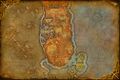
Map of Durotar in Cataclysm.
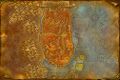
Map of Durotar in Wrath of the Lich King.


Travel hubs

The Horde capital city, Orgrimmar, is located in this zone and is a major travel hub for Horde characters. In addition, the zeppelin towers inside Orgrimmar can carry players to the Eastern Kingdoms, to either Undercity or Grom'Gol Base Camp and also the continent of Northrend, to Warsong Hold.
Flight paths from Orgrimmar
- Razor Hill, Durotar
- Thunder Bluff, Mulgore
- Crossroads, Northern Barrens
- Nozzlepot's Outpost, Northern Barrens
- Ratchet, Northern Barrens
- Southern Rocketway Terminus, Azshara
- Bilgewater Harbor, Azshara
- Valormok, Azshara
- Mor'shan Rampart, Ashenvale
- Splintertree Post, Ashenvale
- Brackenwall Village, Dustwallow Marsh
- Gadgetzan, Tanaris
- Everlook, Winterspring
- Gates of Sothann, Mount Hyjal
Flight paths from Razor Hill
- Orgrimmar, Durotar
- Sen'jin Village, Durotar
Flight paths from Sen'jin Village
- Razor Hill, Durotar
Adjacent regions
| Zone name | Faction | Level range | Direction | Access |
|---|---|---|---|---|
| Thunder Bluff | |
1 - 20 | Southwest | By zeppelin from Orgrimmar to Spirit Rise or by flight path from Orgrimmar. |
| Tirisfal Glades | |
1 - 20 | Northeast across the Great Sea | By zeppelin from Orgrimmar to a tower outside the Undercity. |
| Northern Barrens | |
10 - 60 | West | By foot across the Southfury River. Flight paths from Orgrimmar. Also possible to swim from Darkspear Strand to Ratchet. |
| Azshara | |
10 - 60 | North | By foot through northern exit of Orgrimmar. Flight paths from Orgrimmar. |
| Ashenvale | |
20 - 60 | Northwest | Swim north along the Southfury River and head west. Flight paths from Orgrimmar. |
| Stranglethorn Jungle | |
25 - 60 | Southeast across the Great Sea | By zeppelin from Orgrimmar to Grom'gol Base Camp, Northern Stranglethorn. |
| Northrend, Borean Tundra |
|
68 - 80 | Northeast across the Great Sea | By zeppelin from Orgrimmar to Warsong Hold, Borean Tundra. |
| Zuldazar |
|
110 - 120 | Southeast across the Great Sea | By ship from the Echo Isles to Port of Zandalar, Zuldazar. |
Notable characters
- Main article: Durotar NPCs
Durotar is home to several orcs and trolls of status. Vol'jin, chieftain of the Darkspear Trolls, dwells in Darkspear Hold on the Echo Isles, off the east coast. In nearby Sen'jin Village, Master Gadrin battles Alliance efforts to gain a foothold in Durotar. From Grommash Hold in Orgrimmar, Varok Saurfang leads the orcs.
Quests

- Main article: Durotar storyline
Durotar is the starting zone for trolls and orcs. Orcs start in the Valley of Trials, while the trolls start on the Echo Isles. The quest range here is levels 1 - 10. Quests in Durotar include a rescue of denizens lost during the Shattering, battles against the human soldiers of Tiragarde Keep, helping to 'tune up' gladiators, and a cautionary tale from a Far Seer.
Resources


Inhabitants
-
Sentient creatures
-
Wild creatures
-
Monsters


In Warcraft III

In Warcraft III: The Frozen Throne, Durotar was the main map of the To Tame a Land mission of the Founding of Durotar campaign. It already contained areas such as Thunder Ridge and Razor Hill. Besides Orgrimmar, it featured many orcish and goblin outposts, such as Gar'Thok's outpost, Neeloc's Outpost, the Goblin Storehouse, the Goblin Observatory and Aicila's Marketplace. The Echo Isles also appeared, with their own unique setting, far enough from the mainland that a zeppelin ride was necessary to get there.
Durotar then had some wildlife which didn't appear later in World of Warcraft:
 Bronze dragons
 Kobolds
 Murlocs
 Sasquatch
 Satyrs (Beast Den only)
 Wildkin
 Dire wolves (Beast Den only)
 Thunder phoenixes
 Spider crabs


It also had the following dungeons: Orgrimmar Tunnels, Beast Den, and some uninstanced monster areas such as a harpy den, a warlock coven, several murloc villages and wildkin nests, a Kul Tiran landing area, a thunder phoenix breeding area and a bronze dragon's lair.
Thunderbloom and shimmerweed were plants native to the region.
In the RPG

History
For many years, Durotar was home to the quilboar. Then Thrall, Warchief of the orcs, brought his race to Kalimdor in search of a new homeland. The quilboar were tenacious but ultimately no match for the unified might of the orc clans. The bristled "boar men" were driven back in a series of decisive orc victories along the northern canyons and ultimately pushed to the most remote regions of Durotar and even into the Barrens. The orcs claim the coastal realm as their own, but the quilboar vow to reclaim it someday. The realm of Durotar - named by Warchief Thrall in honor of his father, Durotan - occupies the east coast of Kalimdor, just across the river from the Barrens. The goblin port of Ratchet stands to the south, with the ruined shores of Azshara some distance to the north. The region is warm and rocky, but not as arid as the rest of the Barrens. A fair amount of vegetation grows thanks to the warm easterly winds blowing in from over the ocean, but truly fertile soil is rare, making farmland precious. Sagebrush on the plains and thin pine forests at higher elevations combine with rugged hills and canyons to break up the landscape. Orcs are by far the major inhabitants of Durotar.
Quilboar cluster in the canyons along the northwestern borders and encroach from the Barrens to the west. Centaur warbands make the occasional foray, and furbolgs and undead have been seen in more than one instance. Herd animals such as deer and goats roam the land, preyed upon by wolves and coyotes.
A number of Horde settlements have been established throughout the region, but much of the land has yet to be tamed. The cities and towns scattered along the frontier are heavily fortified against attacks from quilboar raiders, centaur warbands, rogue furbolgs, and even sudden appearances by undead and the occasional demon. Caravans are common targets, creating a strong market for caravan guards.
The few large cities are distant from one another, with a variety of smaller encampments and villages scattered in between. Given that Durotar is the orcs' new homeland, Horde races and independents are welcome throughout the region. Alliance races risk their lives when they venture into Durotar.[18]
The orcs and the Darkspear tribe trolls led by Warchief Thrall landed here after their exodus from the Eastern Kingdoms. They proceeded to explore the area, helping the tauren drive out the cruel centaurs who were harassing Cairne Bloodhoof and his people.
After the war against the Burning Legion, Durotar was founded as a nation and the new orcish homeland by Thrall. The young warchief named the land after his father, Durotan. Upon this land, he laid the ground for the orcs' new capital city Orgrimmar, named for the previous warchief and hero of the Horde, Orgrim Doomhammer.
The capital, Orgrimmar, is host to 14,000 inhabitants. In all, Durotar has a population of 21,000, the majority of which is of orcish blood. 65% of those living here are orcs, 20% are trolls, 15% are tauren, 8% Forsaken, and the smallest, humans, at 2% of the population. It is ruled as a tribal chiefdom by Warchief Thrall. Major settlements include Orgrimmar, Razor Hill, and Sen'jin Village, with respective populations of 14,000, 3,000, and 2,000. Spoken here are the languages of Orcish, Common, Low Common, Taurahe, and Zandali, otherwise known as Troll.[19]
People and culture
- From the journal of Brann Bronzebeard:
Durotar is the most populated of all Horde-controlled regions, as well as their cultural center. Here, young orcs, tauren, and trolls study shamanism and hunting. There is a strong sense of unity here, although a number of Horde members are disturbed by the growing presence of the Forsaken in their lands. I expected this central point for the Horde to also be a major battlefield, and that I would be attacked on sight — I couldn't have been more wrong. Most of the people here are trying to live normal lives, focusing on agriculture and spiritual pursuits. That doesn’t mean their guards didn’t try to rough me up, but after I put the first couple of them on the floor, the rest were smart enough to realize they would be dead if I wanted them to be. After that, most of the people left me alone — a few were even willing to talk to me. I suspect some of them had never seen a dwarf before.
Beyond the Horde, harpies, centaur, and quilboar are prevalent in specific regions of Durotar, attacking caravans and neighboring villages. These prove to be some of the first challenges for young warriors before they move on to bigger battles; these creatures are hardly organized enough to pose a major threat.[19]
Notes and trivia
- According to some stories, the orcs settled this harsh land as a penance for the past.[20]
- The demonym for something that hails from Durotar is "Durotarian".[21]
- One of Rokar Bladeshadow unreleased quests compared Draenor to Durotar.[22]
- Despite its aridity, Durotar includes some excellent farmland. The orcs used to trade their surplus crops with the humans of Theramore down south in exchange for fish.[24]
- The game manual for The Burning Crusade mentions that from then-current point in history (year 25 or 26), two years had passed since the founding of Durotar, meaning that Durotar was founded in year 23 or 24. The Ultimate Visual Guides imply that Durotar was named, established and began to be settled right after the orcs arrived in Kalimdor and before the battles at Stonetalon Peak and Mount Hyjal).[25] World of Warcraft: Chronicle Volume 3 reinforces the Burning Crusade manual version which says that Durotar was established after the Battle of Mount Hyjal.
- Classic Durotar used to have Corrupted variants of several local mobs, such as the Bloodtalon Scythemaw, Dreadmaw Crocolisk, Mottled Boar, Scorpid and Surf Crawler. There was no real reason for these mobs to exist, and they were all removed in Cataclysm.
- A possible explanation for the corruption might have been the Burning Blade cultists who were active in the area.
- This area was planned to be available in the Southern Barrens warfront.
Speculation

|
This article or section includes speculation, observations or opinions possibly supported by lore or by Blizzard officials. It should not be taken as representing official lore.
|
The Warcraft III multiplayer melee map Excavation Site states that an unexplored city was excavated near Durotar by Gazlowe's engineers. Its origin is unknown, but coupled with the presence of troggs in Ragefire Chasm underneath Orgrimmar it might indicate the presence of a Titan site beneath the zone.
Gallery
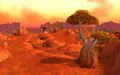
Durotar in World of Warcraft.
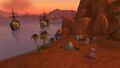
Alliance ships off the southern coast of Durotar in Cataclysm.


- Warcraft III

A warlock coven in The Frozen Throne.
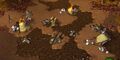
Morg Wolfsong's shaman caravan.
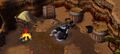
Chen Stormstout's camp.
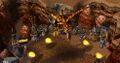
The lair of a bronze dragon.
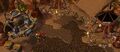
Gar'Thok's watch post.
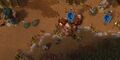
A Kul Tiran landing area.
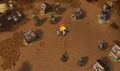
More Kul Tiran forces.

The ambush at Razor Hill.
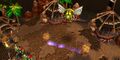
Zeppelin to the Echo Isles.


Videos
Patch changes
- Patch 8.2.0 (2019-06-25): Level scaling increased to 60, previous zone level: 1 - 20.
- Patch 7.3.5 (2018-01-16): Level scaling implemented, previous zone level: 1 - 10.
- Patch 5.3.0 (2013-05-21): Darkspear Rebellion breaks out. Garrosh deploys Kor'kron to dispose any intrusion and fortifies the coast.
- Patch 4.0.3a (2010-11-23): Zone completely renovated for Cataclysm.
- Patch 1.7.0 (2005-09-13): Entering the zeppelin tower at Durotar no longer incorrectly flags you as being in the Valley of Strength.
- Patch 1.6.0 (2005-07-12):
- Durotar has been converted over to the new graveyard system. The system will place your character's spirit at the closest allowed graveyard in the zone.
- A Horde-only graveyard has been added in the northern section of Durotar, just to the south of Orgrimmar. In addition to serving northern Durotar, Horde characters dying in Orgrimmar, The Hall of Legends and Ragefire Chasm will use this new graveyard. Alliance characters dying in Durotar will continue to only use the Razor Hill graveyard.
References
- ^ Rise of the Horde, pg. 353
- ^ Rise of the Horde, pg. 266
- ^ To Tame a Land (WC3 Orc)#Loading screen
- ^ [10] Encroachment
- ^ Timeline (from official site, 2007)
- ^ Cycle of Hatred
- ^ World of Warcraft: Game Manual
- ^ Bloodsworn
- ^ Jaina Proudmoore: Tides of War
- ^
 Defending Durotar
- ^ Salvaging Tiragarde
- ^ [40-70] Tyranny of the Light
- ^
 Investigating the Rumors
- ^ World of Warcraft: Exploring Azeroth: Kalimdor, pg. 10
- ^ World of Warcraft: Exploring Azeroth: Kalimdor, pg. 20
- ^ World of Warcraft: Exploring Azeroth: Kalimdor, pg. 12
- ^ Creepy Crawly
- ^ Warcraft: The Roleplaying Game, pg. 196 - 197
- ^ a b Lands of Mystery, pg. 34
- ^ World of Warcraft: Exploring Azeroth: Kalimdor, pg. 10
- ^ Vol'jin: Shadows of the Horde, pg. 7
- ^
 [16] Rokar's Test
- ^ The Long March (WC3 Orc)#Quotes
- ^ Cycle of Hatred, chapter 5
- ^ World of Warcraft: Ultimate Visual Guide pg. 30 & 47
External links
| Durotar | Warfront | ||
|---|---|---|---|


| |||||||||||||||||

es:Durotar fr:Durotar pl:Durotar