
Draenor
- This article is about the history, geography of the world of prime universe's Draenor up to its destruction. For the history after its destruction, see Outland. For the parallel, alternate timeline's Draenor featured in Warlords of Draenor, see Draenor (alternate universe). For Draenor in the Warcraft film universe, see Draenor (film universe).
 Draenor Draenor | |
|---|---|
 | |
| Type | World |
| Races |
      Orc Orc  Draenei Draenei  Ogre Ogre Ogron Ogron Gronn Gronn Magnaron Magnaron Colossal Colossal Botani Botani Podling Podling Draenor ancient Draenor ancient Genesaur Genesaur Sporemound Sporemound  Arakkoa Arakkoa Saberon Saberon    Fury Fury |
| Languages | Orcish, Draenei, Ravenspeech, Ogre |
| Location | Great Dark Beyond |
| Status | Largely destroyed; remnants transformed into Outland |
“Draenor was a land of magma and metal, stone and steam.”
Draenor, [ˈdɹænɔɹ] called Dawgar ("the Known Earth") by the ogres and Rakshar ("the Sunstone") by the arakkoa,[1] was the homeworld of the orcish race and the last refuge of the draenei before their arrival on Azeroth. It was a large, fertile world dominated by vast plains, dense forests, and lush swamps. Besides the orcs and draenei it was originally home to many other intelligent humanoid races, including the ancient, bird-like arakkoa, the vicious, cat-like saberon, the mighty ogres and their brutal gronn masters, and the aggressive tree-men known as botani.
Due to the corruption of fel, during the last days of its life, Draenor was a transformed world. Now a barren husk of badlands and hardscrabble vegetation, all under a blood-red sky,[2] the planet was referred to as the Red World.[3] When the orc shaman Ner'zhul recklessly opened dimensional portals to find new worlds to conquer, Draenor was torn apart and believed completely lost. However, a large fragment of the world remained intact. That fragment is known today as Outland.
Background

Grond and the Evergrowth

Draenor formed without a titan world-soul. Abundant in the element of Spirit, life flourished, creating a savage ecosystem with a fierce and competitive food chain. At the top of the food chain was a carnivorous plant species known as the Sporemounds,[4] which would eventually gain communal sentience with the rest of Draenor's plant life after tapping into the Spirit that suffused the planet's soil, becoming collectively known as the Evergrowth. If any major threat arose, the Evergrowth reacted in unison. However, such threats were non-existent, for the Evergrowth dominated everything in sight.[4]
When the titan Aggramar came across Draenor in his travels, he was intrigued by the world, but foresaw its doom at the unchecked expansion of the Evergrowth. Unwilling to leave Draenor to its fate, yet unable to combat the Evergrowth himself lest he risk damaging the world itself, Aggramar knew that he would need to neutralize the Sporemounds, the heart of the Evergrowth's power.[4] This led to Aggramar's creation of Grond, a mighty servant formed from a mountain in the titan's image. Grond began marching across the world to conquer the Evergrowth, conquering the Sporemounds and tearing them from the earth.
Mere roots would not topple Grond; instead, the Sporemounds began to adapt.[4] Draining the life essence of the surrounding forests and jungles, three Sporemounds arose and walked to face Grond: Zang, Naanu and Botaan. Although the Evergrowth allowed the three Sporemounds to fight in unison, Grond's elemental might allowed him to crush Zang and Naanu. Zang's corpse would become the Zangar Sea, and Naanu became Tanaan Jungle.
Despite these victories, Grond began to weaken, and eventually fell to the last Sporemound, Botaan. Grond's body crumbled, and much of his corpse then formed a mountain range at the edge of a region that would later be called Nagrand.[5]
Grond's death also released the primordial elemental energies that once gave him life, allowing the elemental spirits of Draenor to take physical form. The greatest among the elementals, the Furies, would come to dwell near the remains of Grond's head, which would become known as the Throne of the Elements.[6]
Other life arose from the battles between Grond and the Sporemounds, from the pieces that fell as the battling parties wounded one another. From the pieces of the Sporemounds emerged a number of plant beings, the most powerful of which were the genesaur. The debris that fell off Grond became the colossals, who, with Aggramar's aid, would continue Grond's fight against Botaan and the new genesaur in the titan's absence.[7][8] From the bodies of fallen colossals, the magnaron arose, and though they felt no loyalty towards their progenitors, still opposed the Evergrowth and fought the genesaur that crossed their paths.
After millennia of constant fighting, the remaining colossals launched a final, suicidal attack on Botaan using titan relics given to them by Aggramar to aid in their battles. The resulting explosion destroyed both parties, scattering their remains. The remains of the colossals sank into the earth and formed veins of blackrock ore, and Botaan's corpse would become the region of Farahlon, the communal sentience of the Evergrowth finally destroyed.[9]
In the years to follow, new beings would arise from those created from the bodies of the colossals and the Sporemounds. When Botaan died, it released spores infused with the Spirit of Life, changing elemental beings into flesh and blood. This would lead to the rise of the gronn, then the ogron, the ogres, and the orcs. From the forests and jungles touched by Botaan's spores came plant creatures, such as the podlings, sporelings, and botani.
This era would later be known as the Age of Colossals.[10][11][12]
The Apexis


The ogres believed that they were the first beings to be created by the Titans (or "Forgers", as they call them), shaped from burning slag when the god-like beings squeezed the light from the great ball of fire that was Draenor.[13]
Long ago, the arakkoa were created by the god Rukhmar atop Gorgrond's highest peak. She taught them about the Light and told them stories of Anzu, who they also worshiped, and from the stories they also began to practice the arcane. She always intended on them returning to Arak, her homeland for which the arakkoa were named, and as she grew old she led them there, three thousand years before the opening of the Dark Portal. But just as they reached Arak, Rukhmar breathed her last breath. Flames consumed her form and she burned like a second sun in the sky. The arakkoa saw Rukhmar's passing as a sign of their ascendancy. They vowed to create a grand civilization that would outshine any other culture on Draenor in order to honor her. The light of their knowledge and their power would blaze in the heavens just as Rukhmar had.[14]
Calling themselves the Apexis, the arakkoa claimed the highest reaches of Arak's spire. They harvested timber from the surrounding woods and metals from the nearby mountains and built illustrious gilded structures around their new home. Using their mastery of the Light, the Apexis crafted enormous lanterns burning with enchanted flames that hung along the length of the spire. Guided by tales of Anzu and his noble sacrifice, arakkoa sorcerers investigated the Sethekk Hollow. By carefully studying the cursed pools, they unraveled the mysteries of shadow magic and developed the unique ability to combine the arcane with the Void. Embracing both Light and Void, the Apexis believed they were both natural parts of life. Two factions formed within the Apexis: the Anhar order studied holy magic, while the Skalax studied shadow and arcane magics. Both groups occupied the upper echelons of arakkoa society, sharing equal prestige and influence.[14]
As the arakkoa solidified their power in Arak, they also began to explore the rest of Draenor; though not expansionists, they were curious. Outposts were forged across the land to observe local flora and fauna, and by studying and mapping the forests and mountains they were in awe when they realized that many of these were the remains of ancient creatures that had once walked Draenor. Based on stories from Rukhmar, the Apexis realized the Primals and Breakers were the primordial giants' offspring. They watched the endless warring between the two with pity and fascination. However, they never intervened; they had inherited a touch of Rukhmar's arrogance and to play a part in the lives of land-dwellers was seen as beneath the Apexis.[14]
Two thousand years before the opening of the Dark Portal, the Apexis developed a device called the Breath of Rukhmar that harnessed the sun's energy into incredible destructive power to combat the Primals and the Sporemound Taala when they encroached on Arak.[15]
Centuries after defeating the Evergrowth and 1,200 years before the opening of the Dark Portal, the Apexis had flourished into an empire and their population had swelled. They saw themselves as the most powerful force in the world, that not even the mightiest of Primals had been able to contend with. With nothing to threaten them, the Apexis dedicated themselves to the advancement of science and magic, and knowledge became their culture's most coveted resource. The Anhar and Skalax became the caretakers of wisdom with the duty of cataloging history, the study of magic, and information about the world and its various creatures. Rather than keeping this knowledge in tomes or scrolls, the Anhari and Skalaxi sorcerers combined their magic to develop Apexis crystals. By merely touching one of the crystals, an arakkoa would consume all of the knowledge contained within and even experience the memories of whoever had crafted it.[16]
The Apexis applied their magics to the creation of mechanical constructs that would do their bidding. The arakkoa had always been arrogant, and they had become even more so after their victory. They deemed those who walked the surface to be unclean and used their constructs to mine and gather other resources from the ground.[16]
During the height of Apexis culture, a small group of Anhari priests sought out the remains of Rukhmar. They found her charred bones near the spire, and they used their magics to resurrect her. But it was only a partial success. This new Rukhmar had only a sliver of the original's power and intelligence. Nonetheless, the Apexis worshiped her as their goddess reborn. The Anhari infused her with their Light powers, granting her a long life so she could soar the skies for millennia.[17]
The Anhari priests constructed a gleaming sun temple around the Breath of Rukhmar used centuries before. Hundreds of arakkoa gathered each year to commemorate the Apexis victory and honor Rukhmar. Other arakkoa visited shrines carved into the solid rock near the foot of the spire where the Skalaxi sorcerers performed rituals to honor Anzu and his ancient sacrifice. Though Apexis culture seemed destined to continue its rise, a rivalry developed between the Anhar and Skalax as each vied for the support of the greater populace. The Anhari knew that to seize power they would need to control knowledge. Their leader Priest-Lord Velthreek order his followers to gather as many Apexis crystals as they could, and the Anhari did so in secret over a number of years, storing them in their sun temple atop the spire.[16]
The Skalaxi and their leader, Sorcerer-Lord Salavass eventually uncovered what was happening. They believed that knowledge was a basic right for all arakkoa and Salavass called for the immediate release of the crystals. However, Velthreek ignored the demand. He declared the Anhari the sole rulers of the Apexis and that they would decide who would access the crystals and their knowledge. In addition, he claimed that he and the Anhari were the living representatives of Rukhmar herself. Therefore, following their teachings was the only way to attain her favor. Salavas was cunning and knew what would happen to his order if they did not act: the Skalaxi would become marginalized in society and gradually lose influence. He gathered his followers and struck at the sun temple to take the Apexis crystals by force.[16]
The battle that erupted at the gates to the sun temple quickly spilled into the lower levels of the spire, with some arakkoa allying with the Anhari and others with the Skalaxi. The civil war engulfed the spire for many months, and to turn the tide of the conflict the Anhari harnessed the Breath of Rukhmar. As the weapon ignited and they prepared to incinerate the Skalaxi, Salavass knew they would be doomed against it and led a handful of his most gifted sorcerers to the top of the spire where they stormed through the Anhari guards. As the Ahhari cut down the intruders Salavass weaved a spell to destabilize the Breath of Rukhmar. It worked, but the result was catastrophic: a furious explosion erupted from the Breath of Rukhmar, instantly kiling most of the arakkoa on the spire and shattering the land. After the light dimmed, all was dark.[16]
The explosion had split Arak's spire into many smaller spires and the surrounding region was left a barren wasteland. In time, it came to be known as the Spires of Arak. It would take generations for life to bloom in the area again, and even longer for the surviving arakkoa to recover from what had happened. The Apexis society was no more and the Age of Order was over, but from its ashes new cultures would arise.[16]
The Gorian Empire

Two hundred years after the fall of the Apexis, a remnant of the Skalaxi led by Yonzi led to the rise of the ogre Gorian Empire when they taught them arcane sorcery to rebel against their ogron slavemasters. They did this to obtain Apexis ruins under the city of Goria, but the ogre they had taught - Gorgog the Gronnslayer - killed Yonzi slowly and gruesomely. Arakkoa ventures into ogre lands became few and far between, and the ogres began to prize Apexis crystals.[18]
The ogres ruled from Goria for six hundred years. This was until Imperator Molok attempted to claim the Throne of the Elements, and the elements themselves, for the empire. His attempts to subjugate both resulted in the near destruction of the former, and the 'wounding' (in a sense) of the latter. This ignited a great war between the ogres and the orcs, as the latter came to the defense of the spirits and eventually laid siege to Goria. Seeing no reason to waste countless lives in an attempt to break down the city's significant fortifications, the orcs were content to keep their distance on the surrounding hills and starve out their enemy. The Gorians believed they could outlast any siege thanks to their ocean port. Due to the tumultuous state of the elements, the orcish shaman were not as effective in calling on their powers as they once had been.[19]
However, as the months passed, the ogres found themselves unable to maintain their empire. Trade via the ocean was not enough; the ogres needed access to their network of land-based trade routes, which the orcs had severed. Imperator Molok and his sorcerers revisited their Apexis crystals, searching for a way to break the siege. In time, they discovered the arakkoan legend about the Curse of Sethe, and began experimenting with ways to create a similar affliction among the orcs. They succeeded, and soon the so-called red pox spread like wildfire through the orcs' encampments, culling vast amounts of the orcish combatants.[19]
The orc Nelgarm and his fellow shaman, realizing that the pox was an unseen attack from the ogres and that the siege was now doomed to fail, beseeched the elements to destroy Goria. The orcs and the elemental spirits both understood that Molok would resume meddling with the Throne of the Elements if the orcs failed, and so the elements agreed to unleash their fury upon Goria. The shaman gathered outside the ogre city's mighty walls and witnessed the fury of the spirits. What happened next would never be forgotten. A roaring storm churned above the city as the ground groaned and trembled. Over several hours, lightning, fire and earthquakes ravaged the city, bringing down every wall and building, sealing off the escape routes and burning the ships in the harbor. When nothing but ash and rubble remained, the earth itself wrenched open like a giant maw to swallow Molok and the remains of his great city whole.[19]
Untold thousands of ogres died that day; none were left alive by the elementals. Only whispers of the event would reach the other Gorian cities and outposts, but those whispers would be enough to discourage any further tampering with the elements. The orcs were victorious, but they had suffered massive losses and witnessed a destructive power they never wanted to see again. Nelgarm and the other shaman were particularly frightened by the elementals' wrath and said that the need for a unified orc army had passed. There was little argument, and the clans returned to their lands.[19]
Arrival of the draenei

Nearly 200 years before Azeroth's First War, the draenei crashed upon this remote world in their naaru vessel, the Genedar.[20][21][22] They believed that this world would be an ideal refuge for their millennia-long exodus and named it Draenor,[23][24] which meant "Exiles' Refuge" in their tongue; since the native orcs did not have a name for the planet—other than simply "world"—they eventually adopted the Draenei term.[25] The settlers quietly cultivated their society once again and kept their magic hidden, ever wary of being discovered again by the Burning Legion's forces. The draenei also built Shattrath City in the location where the city of Goria once stood.[26] The talbuks that they had brought along from their homeworld of Argus proved capable of surviving on their own on the new world, becoming integrated with the native ecosystem.[27][28]
Their arrival, however, placed a literal dark burden on the planet. One of the naaru on board, K'ara, was severely injured in the crash and flung into orbit where it entered the 'darkened' stage of a naaru's life-cycle. As a dark naaru its presence was felt by the orc clan who dwelled in the Shadowmoon Valley who called it the 'Dark Star'. Some of its members even began to channel the darkness that K'ara produced, allowing them to defile the dead and summon Void creatures. In horror, the chieftain of the Shadowmoon clan banned the use of shadow under any circumstances.
Rise of the Horde

For generations the orcs lived in a clan-based, shamanistic society that existed in deep harmony with the surrounding natural world, though frequently clashed with ogre clans and occasionally the reclusive Primals. Their peaceful way of life, however, ended when the Shadowmoon clan's chieftain, Ner'zhul, was tricked into forming an alliance with the Burning Legion. When he attempted to back out of the deal, his apprentice Gul'dan eagerly betrayed and succeeded him. Gul'dan's manipulations transformed the orcs into a unified army of bloodthirsty conquerors, ultimately leading them to drink the blood of the demon lord Mannoroth and become bound to the will the Legion. The warlock magics wielded by the corrupted orcs turned much of Draenor's vibrant landscape into a dusty wasteland as they, under orders from Mannoroth's master Kil'jaeden, decimated the draenei, enslaved the ogres, and took dark dominion over the world. Velen, leader of the draenei, survived the orcish genocide and fled with the remnants of his people to the fungal swamps, where they once more hid themselves from the gaze of the Legion. Before the Orcish Horde could destroy itself in its bloodlust, Gul'dan, acting in concert with the possessed human Medivh, opened the Dark Portal, connecting the worlds of Azeroth and Draenor. The orcs spilled through into an unsuspecting world and started a new war – one that would ultimately pave the way for the Burning Legion's second invasion of Kalimdor.
Destruction of Draenor

- Main article: Outland
Despite its surprise assault and demonic backing, the orcish horde was eventually beaten back by the forces of the Alliance of Lordaeron, and Draenor became the focus of a furious counterattack via the same Dark Portal the orcs had used to invade Azeroth. In the midst of the ensuing battle, the elder shaman Ner'zhul attempted to provide his fellow remaining orcs a means of escape by opening more dimensional portals to other worlds; his reckless use of magic backfired, however, and the presence of so many portals began to tear the very fabric of the planet apart, causing massive tidal waves, earthquakes, and volcanoes to erupt.[29]
In a desperate bid to save Azeroth from the impending chain reaction, the ill-fated but heroic Alliance Expedition closed the Dark Portal from Draenor, trapping themselves there even as it began to crumble beneath their feet.[30] Draenor's remnants were hurled towards the Nether and they became known as Outland.
Though Ner'zhul's gambit had doomed Draenor itself, it did not doom his people: Many orcs managed to weather the savage storm of Draenor's end, while others escaped the destruction of their homeworld by remaining in Azeroth during the Alliance counterattack. Of these survivors, some would go on to be captured and enslaved, others would eke out a living as free but listless warriors on the fringes of a foreign world, and one would even prove strong enough to rise from the ashes of a broken land. Their deeds would go on to deeply affect Draenor's future – or perhaps, more accurately, its past.
Of the draenei and Alliance present on Draenor at the time; many of the former survived, though mutated, and managed to cobble together a meager existence in the wilds of the shattered world. Others, notably Turalyon and Alleria, were saved by the naaru prime Xe'ra and recruited into her Army of the Light to crusade against the Burning Legion.
Alternate timeline
- Main article: Draenor (alternate universe)
35 years ago, on an alternate version of Draenor, a rogue Bronze Dragon and Garrosh Hellscream arrived to instigate the creation of a different horde. Kairoz was killed and Garrosh took charge of the dragon's plans and manipulated this universe's version of Grommash Hellscream into binding the orc clans into a single force united by their iron will called the Iron Horde. Equipped with advanced Goblin technology from the main-universe Azeroth's modern day the Iron Horde eagerly pursues their new destiny as free-willed, but equally cruel and bloodthirsty conquerors.
Geography
- Ashran, known as Deathwing's Lair during the invasion of Draenor.
- Barrier Sea, known as the Devouring Sea during the invasion.
- Farahlon, sundered into Netherstorm when the planet was destroyed.
- Frostfire Ridge and Gorgrond, later merged as the Blade's Edge Mountains when the planet was destroyed.
- Nagrand
- Talador, changed into Terokkar Forest and the Bone Wastes.
- Tanaan Channel, known as the Shadowed Seas during the invasion.
- Tanaan Jungle, scorched into Hellfire Peninsula before the Second War.
- Shadowmoon Valley
- Spires of Arak, destroyed alongside the planet although Skettis remained in Terokkar Forest.
- Zangar Sea, transformed into Zangarmarsh at an unknown point.
Outposts and cities
The draenei
- Shattrath City (draenei capital)
- Auchindoun (necropolis)
- Temple of Karabor (sanctum of the Prophet)
- Farahlon
- Sha'naar
- Telmor
- Telredor
The Horde
- Hellfire Citadel (Horde capital)
- Black Temple (formerly Temple of Karabor)
- Fortress Shadowmoon
- Fortress Auchindoun
- Zeth'kur
- Zeth'Gor
In the RPG

Draenor ceased to be a material world, and its barely-hospitable remnants were rechristened Outland – the torn fragments of a once verdant realm cursed to float in the darkness of the Nether until the end of time.[31]
Notes
- The lands we visit in Outland is only what remains of the central continent; others exist on the planet, but were destroyed when Draenor was shattered into Outland.[32]
- The draenei temporarily visited dozens of worlds aboard the Genedar,[33] but not all of them were aboard the ship. After the crash of the Genedar, it was said that there were still other naaru and draenei besides those left stranded on Draenor.[34]
- The rivers of Draenor were filled with moray.[35]
Gallery
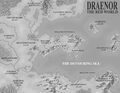
A map of the world of Draenor around the Dark Portal.
Another map of Draenor.
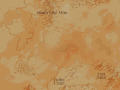
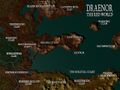
Draenor as seen in the PlayStation version of Warcraft II.


- Fan art

Draenor from space.

Videos
References
- ^ World of Warcraft: Chronicle Volume 2, pg. 12
- ^ The Last Guardian, chapter 12
- ^ Warcraft II: Beyond the Dark Portal missions#Act I Draenor, The Red World
- ^ a b c d World of Warcraft: Chronicle Volume 2, pg. 12 - 13
- ^ World of Warcraft: Chronicle Volume 2, pg. 14 - 16
- ^ World of Warcraft: Chronicle Volume 2, pg. 14
- ^ World of Warcraft: Chronicle Volume 2, pg. 17
- ^ World of Warcraft: Chronicle Volume 2, pg. 17 - 18
- ^ World of Warcraft: Chronicle Volume 2, pg. 19
- ^
 [100R] Might of the Elemental Lords
- ^ Beasts of the Savage Lands - Shadowmoon Valley
- ^ Beasts of the Savage Lands - Gorgrond
- ^ Code of Rule
- ^ a b c World of Warcraft: Chronicle Volume 2, pg. 24 - 25
- ^ World of Warcraft: Chronicle Volume 2, pg. 25 - 29
- ^ a b c d e f World of Warcraft: Chronicle Volume 2, pg. 29 - 32
- ^ World of Warcraft: Chronicle Volume 2, pg. 33
- ^ World of Warcraft: Chronicle Volume 2, pg. 37 - 38
- ^ a b c d World of Warcraft: Chronicle Volume 2, pg. 49
- ^ Micky Neilson on Twitter: Rise of the Horde and the WoW Comic said that the Draenei arrived to Draenor 200 years before W1. That's still accurated? "Yep, Historians confirmed."
- ^ Rise of the Horde - "It was over two hundred summers ago that your people came here. We were not as We are now."
- ^ The Comic Volume 4
- ^ Beyond the Dark Portal - "Draenor is name they call world, yes. They proud of selves, they name whole world for selves. They strong . . . before."
- ^ Rise of the Horde - And they had named the world Draenor., or "Exiles' Refuge"
- ^ Rise of the Horde, pg. 57
- ^ World of Warcraft: Chronicle Volume 2, pg. 53
- ^ Ornyx 2017-08-02. Argus wildlife question.
- ^ Echo of Argus talbuks seen during [45] Eredath, Jewel of Argus
- ^ The Bitter Taste of Victory (WC2 Human)
- ^ Beyond the Dark Portal
- ^ Dungeons & Dragons Warcraft The Roleplaying Game, pg. 157
- ^ A Thousand Years of War
- ^ World of Warcraft: Chronicle Volume 2, pg. 63
- ^ World of Warcraft: Chronicle Volume 2, pg. 53
- ^
 [Slithershock Elver]
| ||||||||||||||||||||||||||||||||||||||
