

Troll
- This page is about trolls in general. For the playable races, see troll (playable), and Zandalari troll (playable).
| Trolls | |
|---|---|
 | |
| Faction/Affiliation | Various |
| Character classes |
 Barbarian, Potion doc, Primal, Wilderness Stalker Barbarian, Potion doc, Primal, Wilderness Stalker |
| Racial capital |
 Zuldazar (Zandalari) Darkspear Isle (Darkspear) Zuldazar (Zandalari) Darkspear Isle (Darkspear) Zul'Gurub (Gurubashi) Zul'Aman (Amani) Zul'Farrak (Farraki) Zul'Gurub (Gurubashi) Zul'Aman (Amani) Zul'Farrak (Farraki) |
| Formerly |
Gundrak (Drakkari) |
| Racial leader(s) |
 Talanji (Zandalari Empire) Talanji (Zandalari Empire)  Rokhan (Darkspear) Rokhan (Darkspear)  Mar'li † (Gurubashi) Mar'li † (Gurubashi)  Kazra'jin † (Amani) Kazra'jin † (Amani)  Ukorz Sandscalp (Farraki) Ukorz Sandscalp (Farraki) |
| Formerly |
 Malakk † (Drakkari) Malakk † (Drakkari) |
| Racial mount |
 Bat Bat Bear Bear Direhorn Direhorn Dragonhawk Dragonhawk Raptor Raptor Rhino Rhino Skyscreamer Skyscreamer  Turtle (Giant Sea Turtle) Turtle (Giant Sea Turtle) |
| Homeworld | Azeroth |
| Environment | Any |
| Area(s) | Eastern Kingdoms, Kalimdor, Northrend, South Seas |
| Language(s) | Zandali, Orcish |
| Organization(s) | Tribes, empires |

“Oh my - as I suspected. Your ancestry dates back to the dawn of the world. Great were the ancient empires of the trolls. I see a spark in your eyes, a powerful will - you wish to be great again, yes?”
Trolls (collectively referred to as trollkind)[2][3] are a diverse sapient race that can be found in every part of Azeroth. They are one of the world's oldest known native races.[4] Trolls are divided into many subgroups adapted to different environments, namely blood trolls, dark trolls, forest trolls, ice trolls, jungle trolls, sand trolls, and Zandalari trolls.
Many trolls have no loyalty except amongst their own tribes, but some important groups have joined the Horde: the Darkspear tribe, Shatterspear tribe, Revantusk tribe, Jellyneck's tribe, and Zandalari Empire. Some forest trolls cling to their allegiance to the Old Horde and its villainous offshoots.
Traits and characteristics

Troll is a race grouped into tribes,[5] with each varying from being tall, lanky, and muscular, and being different than the others both physically and culturally. They have both elven and orc-like characteristics with their fierce tusks and long ears. Their long arms, strong legs, quick reflexes as well as their incredible agility and strength make them adept hunters.
Trolls have three fingers, and three toes with one protruding from the heel. Most trolls do not wear standard shoes or boots as they are simply more comfortable barefoot, however, some do.[6][7] And adorning them for battle or war is done by some.[8] Their smell can be used to repel all kinds of beasts.[9]
Male trolls frequently squat in place, while the females do not.[10]
Trolls and their various subgroups are some of the tallest mortal races on Azeroth. Both males and females have a variety of tusk styles ranging from small to large, they also feature a wide range of wild hairstyles,[10] though mohawks are very common. The three largest subgroups of troll are the dark trolls, ice trolls, and the Zandalari trolls, who on average are much larger than their kindred.[11] There is another variant of troll–albeit not a subgroup–that far exceeds the normal size range, these trolls are called dire trolls.[12]
Forest trolls' bodies can support plant life to a limited extent due to a mutation that took place many millennia ago. A thin layer of moss may grow on their skin shortly after they are born, giving them their characteristic greenish color.[13]
Jungle trolls' bodies are covered in short, soft fur which causes them to appear purple or gray.[14] However, their range of color is even broader as many appear in shades of blue as well as tints of green.
Vol'jin in Kun-Lai stated that the human Tyrathan Khort could cope with the cold better than he could. However, he managed to get used to it very rapidly.[15] With how naturally adaptable trolls are, (as confirmed by their numerous subgroups), it wouldn't be surprising if this wasn't true for most trolls.
Trolls have a characteristic way of speaking. Words like "yo" (a greeting) and "mon" (man) are common expressions. They speak with varying Caribbean and African-accented English.
Troll regeneration
“My arm be broke, a few ribs snapped, t'ink even me spleen be hurtin' from dat beatin'. Nothin' a troll can't handle though . . .”
Although enough physical damage can kill them, all trolls possess incredible physical resilience and can regenerate grievous physical injuries at an astonishingly accelerated rate,[16][4] giving them a large advantage in battle. All trolls are naturally able to regenerate lost limbs and organs thanks to their unique physiology.[16][4][17][18] Meaning they do not need the blessings of a loa to be able to regenerate, but the ability can be amplified or taken away by them.[19]
Examples
- Trolls are capable of regenerating a crushed throat and shattered jaw during the heat of battle, allowing them to continue fighting.[20]
- Broken arms and snapped ribs are quickly healed, needing only a moment to "pop back in place."[21]
- Trolls are able to survive evisceration, as well as being shot in the throat or eye with an arrow.[22] It is likely the latter requires the brain to not have been hit, unless a very rare exception.
- If an arrow punctures a troll through and through, the wound will be regenerated in mere seconds if the arrow is removed.[23]
- The complete regeneration of a lost hand is a relatively quick process.[24]
- Trolls can survive being stabbed through the neck and throat,[25] even when their regeneration is slowed by a poison, something any other race than a troll would die to.[26]
- The most dedicated troll drummers allow themselves to be flayed alive so that they may use their own skin for the drums they play. It is thanks to their incredible natural regeneration that they survive the grueling ordeal.[27]
The average speed of regeneration is not entirely known, however. While there are several impressive and rapid feats, there have also been examples of trolls that have been depicted as critically wounded and at least temporarily disabled by their injuries in World of Warcraft.
Control
Trolls are capable of controlling their regeneration, though how they do so is unknown, but a troll can make a conscious decision to not heal a scar as to leave a mark of what has happened to them. An example of this is Vol'jin who—after having been the victim of an attempted assassination—decided to not fully heal his throat and lung, as a reminder of his mistake to accept Garrosh's mission. The scar left upon and inside his throat also altered his voice, making it sound unmelodious.[17]
It is most likely this control that allows trolls to retain piercings, tattoos, and other bodily modifications that would otherwise be considered damage needing to be repaired by the body.
Weaknesses
- A loa can strip the regeneration from a troll, rendering them incapable of regenerating limbs and even flesh wounds.[28][19]
- There is a type of poison that can block a troll's regenerative abilities until it is purged from the body.[26]
- There appears to be some kind of weapon enchantment that can temporarily prevent troll regeneration, as evident by the effects that the sword Trol'kalar has upon trolls.
- Though the commonality of said enchantment is unknown.
- Elemental fire is an effective weapon against trolls, temporarily preventing trolls from regenerating their wounds.[29]
- Ordinary fire seems to have the same or at least a similar effect. Before the Second War, human soldiers used torches to capture Zul'jin,[30] and Stromgarde Troll Hunters wield torches to accompany their main weapon.
- The best way to ensure a troll stays dead is to decapitate them; otherwise, they are likely to regenerate and come back for you.[31]
Culture
Troll children are taught about those cursed by the loa, unable to heal even flesh wounds, to instill the proper respect for their patron spirits.[19]
Some trolls believe that Lukou the loa of regeneration gifted trolls with the ability to regenerate.[32]
There are tales in troll culture about those blessed by the loa that can regenerate nearly the entirety of their bodies. The tale of Vula'jin the Void speaks of how he regrew almost his entire body after standing in a pool of shadowflame.[19]
The Zandalari merchant Tik'su charged trolls for their arms and legs as a result of trolls being able to regrow their limbs.[18]
Trivia
Trolls are so well known for their regenerative abilities that there are alchemical mixtures—which induce some form of regeneration—referred to as "troll's blood elixirs" despite not actually containing any troll blood, judging by the reagents used to make them. When it comes to troll blood, however, an interesting thing to note is that sand troll blood is thick enough to hold in your hand.[33]
Retcons
Troll regeneration has been subject to inconsistencies over the years and has fluctuated in terms of strength and whether it was natural or a blessing from the loa. Though while it has remained fairly consistent in some cases, below is a list of retcons and inconsistencies.
- In Warcraft II: Tides of Darkness, troll regeneration was originally stated to be limited to troll berserkers after ingesting potions made by goblin alchemists.[34]
- In Warcraft III: Reign of Chaos, "Troll Regeneration" is an upgrade available to the Orc (Warcraft III) race which increases the HP regeneration of all troll units. There is however no lore to accompany the upgrade itself and none of the troll units' information mention regeneration, making its source and application more ambiguous than in Warcraft II.
- The Troll Compendium – published before the release of World of Warcraft – mentions that trolls are capable of regenerating lost limbs and implies it to be entirely natural.
- In the short story The Judgment – published during World of Warcraft: Cataclysm – the following was stated:
- "All trolls were blessed by the loa with some regeneration. They could regrow fingers and toes, even if more complex parts like limbs and organs were beyond their abilities."
- Around the same time, Ask CDev round 2's answers were published and contained a question about why Zul'jin did not regrow his arm back and the following was part of a longer answer:
- "When in balance with the loa of their tribe, they are also able to regrow digits (fingers and toes)."
- In the same expansion, however, the archaeology profession was introduced to the game where players could discover the Haunted War Drum which stated once again that the trolls' incredible regeneration was natural, thus causing conflict with the above two as it reaffirmed the Troll Compendium.
- In the novel Vol'jin: Shadows of the Horde – published during World of Warcraft: Mists of Pandaria – several incredible regenerative feats were mentioned, especially during combat. There was also an instance of regeneration of a lung, further invalidating The Judgement and Ask CDev.
- In World of Warcraft: Chronicle Volume 1 – published before the release of World of Warcraft: Legion – it was stated that the trolls' unique physiology allowed them to recover from physical injuries at an astonishing rate, even being able to regenerate lost limbs, completely invalidating The Judgement and Ask CDev.
See also


History
Ancient history
At the heart of ancient Kalimdor lay the Well of Eternity, an enormous lake filled with powerful energies. The Well accelerated the cycles of growth and rebirth on the primordial continent, and soon sentient life forms arose from the wilds. The trolls were among the first and most prolific.[4]
Trolls are one of the oldest races on Azeroth. Before the days of empires such as the Empire of Zul, the shadow hunters were the leaders of small groups of trolls that over time formed small tribes.[35] Over 20,000 years ago, trolls made villages constructed out of straw huts. Though mainly centered in the southern parts of Kalimdor, they ventured as far north as the Dragon Isles.[36] The first center of troll civilization was in Nazmir.[37] Over time, as trolls gathered in great cities, the influence of the shadow hunters was lessened. Despite this, the position is still a highly respected one.[35]
The early trolls developed an array of superstitious customs. Some practiced cannibalism and warfare, others mystic practices and meditation, and others honed their ties to the dark and powerful form of magic known as voodoo. What all trolls shared was a common religion centered around Kalimdor's Wild Gods, which the trolls worshipped as deities under the name "loa". The troll tribes gathered near the sacred mountain range of Zandalar in southern Kalimdor, where many of the loa dwelt. The lesser tribes built small encampments on Zandalar's slopes, but the most powerful tribe, the Zandalari, claimed the highest peaks and plateaus. There, they built a cluster of shrines that would later come to grow into the temple city of Zuldazar.[4] The tribes would then unite under the first tamer of raptors King Dazar[38] and form the Zandalari empire.[39]
Empires

About 16,000 years ago (long before the night elves summoned the wrath of the Burning Legion), trolls lorded over much of Kalimdor, which was then a single continent. The Zandalari were the earliest known trolls - the first tribe from which all tribes originated.
The Zandalari Empire was heavily dependent on a caste system, and as time went on those castes evolved into their own people. The lower castes eventually left the Zandalari Empire, and the Zandalar trolls were content to see them go, seeing them as children who would see the folly of youthful rebellion and come back begging for Zandalari approval.[40]
However, the trolls would not return. Over time two distinct troll empires emerged: the Amani Empire of the middle forestlands and the Gurubashi Empire of the Southeastern jungles. Smaller tribes lived far North in the region now called Northrend. These tribes founded a small nation known as Zul'Drak, but they never achieved the size or prosperity of the southern empires.
It was not uncommon for these powerful tribes to go to war with each other, usually over disputed territories or for specific resources. For the most part, however, these wars were benign and rarely lasted long enough for any major conflicts to occur. The trolls were so very skilled at hunting and fighting that any large confrontation would prove to be extremely costly for all parties involved, regardless of which side won. Untouched and unclaimed land was plentiful in every direction, and the various factions quickly realized that it was wiser to resettle or withdraw rather than to risk an open and potentially costly war.[41]
There was only one location which the trolls were actively forbidden from disturbing by their priests and mystic. This was a dark mound of blackened earth and stone located at the base of the Zandalar Mountains. The loa warned troll priests of severe consequences should they disturb this place, and for centuries none dared to. Eventually, however, a group of curious and rebellious trolls led by the Gurubashi outcast Zan'do resigned to throw caution to the wind and plumbed the forbidden mound. What they discovered was that the black stones were not rocks—they were the jagged hide of a large and monstrous creature. Stunned and excited by their discovery, they incorrectly believed that what they had unearthed was a loa. They further concluded that this loa must be one of a particular power, as the other spirits appeared to be afraid of its presence. Determined to awaken this being, the trolls performed vile ceremonies and rituals, including living sacrifices. Roused by the ritually-spilled blood, a gigantic C'Thraxxi general known as Kith'ix emerged from its millennia-long slumber and immediately viciously slew those who had revived it.[42]
Kith'ix, fully awakened, knew it would delight the Old Gods to see this pitiful civilization rent to ashes. It reached out with its mind and took control of the aqir dwelling underground. The aqiri swarms began building a vast subterranean empire known as Azj'Aqir, and when they had swollen enough in number, the C'Thrax led them to make war against the trolls in a conflict now known as the Aqir and Troll War.
The aqiri threat was unlike any the trolls had ever faced. As they got dangerously close to the Zandalar Mountains, the Zandalari moved to act. They united the disparate troll tribes into a single mighty force, which they called the Empire of Zul. Its members would put aside their differences and work together to destroy the aqir.
The trolls fought the aqir for many thousands of years but never succeeded in winning a true victory over them. Eventually, due to the trolls' persistence, the aqiri kingdom split into thirds as its citizens fled to separate colonies in the far Northern and Southern regions of the continent. Three aqiri kingdoms then emerged: Azjol-Nerub in the Northern wastes, Ahn'Qiraj in the Southern desert, and Manti'vess near the domain of mogu. Though the trolls suspected that there were other aqiri colonies beneath Kalimdor, their existence was never verified.[43]

With the insectoids driven into exile, the twin troll empires returned to normalcy. Despite their great victories, neither civilization expanded much further than their original boundaries.[43] However, ancient texts speak of a small faction of dark trolls who broke off from the Amani Empire and founded their own colony in the heart of the dark continent. There, the pioneers discovered the cosmic Well of Eternity, which allegedly transformed them into beings of immense power. Some legends suggested that these troll adventurers became the first night elves, and this was later confirmed by Freya, Cenarius, and the Tribunal of Ages when asked by the legendary explorer, Brann Bronzebeard.[44][45]
Then 15,000 years ago the Zandalari allied with the mogu and their empire, but both the mogu and Zandalari held contempt for one another. The Zandalari thought themselves above the mogu for two reasons: the presence of the loa, and that the Zandalari did not use slaves as the mogu did. The mutual contempt between the two would grow to polite indifference. They trusted the other not to attack because they were confident they would defeat the other. While Zandalari and mogu stood back to back, they did not watch the other and did not see the other falter.[40]
Empires' fall

After their discovery of the Well of Eternity, the descendants of these dark trolls, now calling themselves "Kaldorei" in their new language, came to power. They started their rise to power by defeating the nearby troll tribes.[46] Against their enemies, the kaldorei used overwhelming military power, their armies supported by Elune's blessings. The night elves' greatest soldiers were bestowed the goddess' fury through dangerous rituals, and these Night Warriors secured Kalimdor for their empire.[47]
Despite the trolls' attempts to keep them from expanding their territories, the night elves built a strong empire that expanded rapidly across primordial Kalimdor. Wielding magics never before seen by their ancestors' kin, who remained largely superstitious, the night elves had little trouble demolishing the trolls' twin empires, an act the aqir could not accomplish.
The night elves systematically dismantled the trolls' defenses and supply chains. The trolls, unable to counter the elves' destructive magics, buckled under the onslaught. The actions of the night elves incurred the trolls' long-lasting hatred and disdain. The Gurubashi and Amani Empires fragmented within only a few short years.
Ultimately, the kaldorei Queen Azshara struck an accord with the Zandalar tribe, which held immense influence over all other trolls. In exchange for ending troll incursions into night elf territory, the Zandalari would be allowed to keep the sacred Zandalar Mountains south of the Well of Eternity. Fully aware they stood no chance against their enemies' arcane powers, the trolls begrudgingly agreed. The night elves' shockingly quick victory and the trolls' shameful acquiescence fostered the trolls' deep resentment and eternal hatred toward night elves,[48] lasting to this very day.
Eventually, the night elves' reckless overuse of magic lured the demonic Burning Legion to the world. The demons destroyed much of the night elves' civilization. Though there are no records to indicate that the Legion attacked either troll civilization, it is likely that battles took place across the breadth of the continent. Some dark gray-skinned trolls guarded Neltharion's Lair, magically kept under the Aspect's sway.[49]
At the end of this conflict, known as the War of the Ancients, the Well of Eternity imploded. The resulting shockwave shattered the greater landmass of Kalimdor. The center of the continent was blasted beneath the sea, leaving a group of multiple, broken, continents. Thus, great chunks of both the Amani and Gurubashi Empires were lost to the waves, but plenty of their land still exists in the present-day lands of Quel'Thalas and Stranglethorn (respectively). The Azj'Aqir kingdoms of Azjol-Nerub, Ahn'Qiraj, and Manti'vess have also survived in present-day Northrend, Kalimdor, and Pandaria respectively.[43]
The troll civilizations recoiled from the vast destruction of the world they had known. The trolls later rebuilt their ravaged cities and set about to reclaim some of their former power.
The Troll Wars
- Main article: The Troll Wars
One of the oldest wars in Azeroth was between the forest trolls of Zul'Aman and the high elves. High elves founded their kingdom of Quel'Thalas over ground sacred to the trolls, beneath which lay an ancient troll city. This sparked conflict between the high elves and trolls, but the elves' magic frightened away the superstitious and angry troll warbands. 4,000 years passed while the trolls plotted and schemed as their numbers grew. Finally, a mighty troll army charged out from the shadowy forests and once again laid siege to the shining spires of Quel'Thalas.[43][50]
The elves were hopelessly outnumbered.[43] Believing defeat to be imminent, the high elves in desperation sought the aid of the humans of Arathor, teaching them the ways of magic in exchange for their assistance. Together the high elves and humans stood against the troll armies at the foot of the Alterac Mountains and used fire magic to set the trolls ablaze and prevent them from regenerating their wounds. The troll armies broke and attempted to flee, but were chased by enemy forces and eventually killed. The forest trolls would never fully recover from their defeat, and history would never see them rise as one nation again.[29]
Wrath of the Soulflayer

The long centuries following the Great Sundering of the world were difficult ones for the troll race. Famine and death were commonplace within the broken kingdoms. The Gurubashi trolls, driven to desperate ends, sought aid from ancient, mystical forces. Though both of the troll kingdoms shared a central belief in a great pantheon of primitive gods, the Gurubashi fell under the sway of a darker one.
1,500 years before the opening of the Dark Portal,[51] Hakkar the Soulflayer (not to be confused with Hakkar the Houndmaster from War of the Ancients), a darker spirit, heard the trolls' calls of distress and decided to aid them. Hakkar gave his secrets of blood to the Gurubashi and helped them extend their civilization across most of Stranglethorn Vale and certain islands of the South Seas. Though he brought them great power, Hakkar demanded souls be sacrificed to him daily. He wanted to gain access to the physical world so that he could terrorize and devour mortal creatures. In time the Zandalari helped the Gurubashi realize what kind of creature they had courted with, and both forces turned against him. The strongest tribes rose up against Hakkar and his loyal priests, the Atal'ai.
The devastating war that ensued between Hakkar's followers and the rest of the Gurubashi tribes was not well-recorded and has mostly been passed on through oral tradition. The budding empire was shattered by the magic unleashed between the angry god and his rebel children. Just as the war began turning away from the trolls' favor, they succeeded in destroying Hakkar's avatar and banishing him from the mortal world.
The Atal'ai priests were eventually driven from the capital of Zul'Gurub and forced to survive in the uncharted swamplands of the North. Within the dense ferns, they built a great temple, Atal'Hakkar, in honor of their fallen god, where they continued to worship and serve him.
The rest of the Gurubashi tribes separated after the great civil war had left their lands in ruins. The Skullsplitter, Bloodscalp, and Darkspear tribes set off to claim their own lands within the vast jungles of Stranglethorn. Though a fragile peace had settled over the broken empire, rumors of a prophecy that Hakkar would one day be reborn into the world spread.[43]
The Horde

When the Horde first arrived on Azeroth the troll tribes initially ignored the orcs, but when the Horde destroyed Stormwind and was moving to destroy Lordaeron, the forest trolls saw the perfect chance to gain vengeance for their defeat in the Troll Wars. Led by the mighty Zul'jin the Forest Trolls proved to be a great asset to the Horde during the Second War and were able to successfully strike against the high elves of Quel'Thalas. However when Warchief Orgrim Doomhammer decided to launch an assault on the humans of Lordaeron instead of continuing the invasion of Quel'Thalas Zul'jin grew furious. The forest trolls ultimately left the Horde when the orcs were defeated and placed into internment camps, with the Revantusk tribe still having a small amount of loyalty to the Horde. The troll race would then return to the former policy of ignoring the Horde until the Third War.
During the Third War, the young Warchief Thrall heeded the Prophet's words to set sail to Kalimdor. On the way, his ships crash-landed on the Darkspear islands and his forces encountered the Darkspear tribe. After helping the Darkspear tribe against the attacking Alliance forces, all sides were captured by murlocs under the command of the Sea Witch Zar'jira. After being saved and following Chieftain Sen'jin's dying wishes the Darkspear tribe swore loyalty to the Horde.
Following the aftermath of the Third War, the orcs sent emissaries to the Hinterlands to renew the bonds of loyalty with their former forest troll allies. While the Vilebranch and the Witherbark refused outright, the Revantusk trolls agreed and have become the Horde's ally.
End of the troll capitals
In Tanaris, Alliance and Horde adventurers have launched constant assaults on the Sandfury troll capital of Zul'Farrak, leaving it a barren wasteland.[52] Although they could not be kept away for long as they returned and tried to sacrifice Aramar Thorne and his companions to the Loa.[53]
In Stranglethorn Vale, the Hakkari and Atal'ai were able to successfully bring forth Hakkar the Soulflayer into Zul'Gurub, with the Gurubashi tribe quickly joining them in hopes of restoring themselves to their former glory. When word of Hakkar's presence reached the Zandalar tribe, they sent a contingent of Gurubashi high priests to stop him.[54][55] When word reached the Zandalari that the priests had been enslaved by Hakkar, King Rastakhan sent emissaries from the island of Zuldazar to recruit champions from Azeroth's many races in the hope that Hakkar could once again be defeated. The Zandalari's call to arms was answered by the proud members of the Horde, who slew the enthralled high priests, the Gurubashi witch doctor Jin'do, and ultimately Hakkar himself, leaving Zul'Gurub but a shadow of its former glory.
After the Blood elves joined the Horde, Zul'jin ventured out of Zul'Aman and became enraged that the Troll's eternal enemy joined with his former ally. He saw the opportunity when most of the blood elves and Horde were busy fighting on Outland. He had his champions harness the power of the loa with the help of the cunning Hex Lord Malacrass. Not wanting to fight a war on two fronts, the Horde sent a task force of some of their strongest champions to kill the Amani leadership.[56] At the entrance to Zul'Aman, adventurers encountered Budd Nedreck, who convinced them to also steal the treasures within as well. With Zul'jin dead the forest troll capital became quiet with the surviving Amani grouping under Daakara.
In Northrend Zul'Drak became under attack by the Undead Scourge. In desperation to counter the Scourge threat, the Drakkari trolls began sacrificing their own loa and draining their power for themselves. The Zandalari went to Zul'Drak to intervene on behalf of the Loa and chronicle the end of the Drakkari empire. The empowered Drakkari soon became power-mad and threatened the forces of the Alliance, Horde, and Argent Crusade who were attempting to fight back the Scourge in Northrend. As a result, the adventurers employed by these forces were, after neutralizing the Scourge threat in the lowest reaches of the city, directed against the Drakkari and, with the aid of the Loa who escaped the Drakkari's plot, managed to take out all of the empowered trolls in the city. These adventurers soon converged on Gundrak itself, and there they slew the remaining champions of Zul'Drak, including their leader; High Prophet Gal'darah.
As a result of these events, the Zandalari considered Zul'Drak to have been destroyed by the Scourge.[52]
A new troll empire

The recent cataclysm has seen the Revantusk become members of the Horde who are fighting to claim the entire Hinterlands for the tribe and the Horde. The cataclysm has also seen the Shatterspear tribe end their isolationist policy and join the Horde which was now under the command of the new Warchief, Garrosh Hellscream.
Meanwhile, a new adventurer who traveled through Stranglethorn would gain the friendship of a raptor chick. Through this chick and its adventurer companion, the Alliance and Horde discovered that Jin'do, now a shade, had enacted a plan to restore the Gurubashi to greatness by resurrecting their high priests and champions (himself included of course) and summoning Hakkar. And while the resurrection of Mandokir and Venoxis was successful, the adventurer managed to throw a wrench into his plans by destroying Jeklik's body and preventing her resurrection.
The Shatterspear was not the only tribe who has seen a change in their stance on the other nations, however. The chaos unleashed by the recent Cataclysm caused immense damage to Zandalar itself and has thus reshaped the Zandalari's stance about the world as well, and the dwindling remnants of their race. Around the time of the Alliance and Horde's siege on the Twilight Highlands, a meeting was then by the mysterious prophet Zul to discuss the fate of their people. Among those in attendance at the meeting are Vol'jin of the Darkspear, Jin'do of the Gurubashi, Daakara of the Amani and an unknown ice troll leader.
There the tribe leaders are reminded of the falls of Zul'Farrak and Zul'Drak. Zul then says that the troll tribes must unite to form a new Troll Empire. He entices both Jin'do and Daakara with promises of restoring Zul'Gurub and Zul'Aman to their former glory. As the other trolls agree to join the Zandalari, Vol'jin begins walking away and only stops when asked if he would betray his people. Vol'jin retorts that the Horde are his people and promises to stop the Zandalari should they bring war to the land.
Knowing that a new troll empire would be a grave threat to Azeroth, Vol'jin has sent Darkspear emissaries to both Orgrimmar and Stormwind, knowing that the Horde alone can not stop the Zandalari. While Vol'jin's efforts have been able to keep the Amani contained within Zul'Aman, the Gurubashi were able to launch an attack on Stranglethorn before being pushed back to Zul'Gurub. Vol'jin's Darkspear have been able to keep themselves entrenched within both Zul'Aman and Zul'Gurub, the Revantusk and Shatterspear tribes have also refused to join the Zandalari and have stayed true to the Horde.
With the aid of Halduron Brightwing's Farstriders and Vereesa Windrunner's rangers, Vol'jin and the Darkspear were able to keep the Amani hold up inside Zul'Aman. After deciding an appropriate battle plan Vol'jin personally leads a strike force into Zul'Aman and with the aid of adventurers puts an end to Daakara which severely weakening the Amani even further and ends Zandalari's efforts within Zul'Aman.
However empowered by the Zandalari's offer the Gurubashi launched an all-out assault to claim Stranglethorn, though with the effort of brave adventurers they are pushed back into Zul'Gurub where Darkspear agents have claimed the entrance. These agents were then able to discover that Jin'do is wrestling Hakkar the Soulflayer into submission, holding him by spirit chains and stripping out his power into himself. With this knowledge, they recruited adventurers who ventured into Zul'Gurub and put an end to the Gurubashi leadership before freeing Hakkar who swiftly killed Jin'do. Thus dealing the Gurubashi a severe blow though and removing the Zandalari's influence, though at the cost of the Soulflayer's freedom.
The return of the Thunder King

When the mists hiding the southern continent Pandaria lifted, the Zandalari realized they had an opportunity to claim the land as their own by resuming their allegiance with the mogu. To cement this allegiance, and their place on Pandaria, the trolls invaded the Kun-Lai region of the continent to find and retrieve the corpse of Lei Shen, the Thunder King and the first emperor of the mogu empire. With their powerful voodoo magic, the Zandalari were successful in resurrecting him, and, shortly after the Alliance and Horde made landfall, the resurrected Thunder King began an earnest campaign to restore the Mogu Empire to glory. He was aided by the united troll forces, with the Council of Elders, a group consisting of the leaders of the Farraki, Gurubashi, Drakkari, and Amani, standing guard over the entrance to his palace.
It wasn't long, however, before the forces of the Alliance and Horde assaulted the Thunder King's palace and eliminated the troll presence within, an act that Lei Shen was thankful for as he considered them 'filth'. Shortly afterwards, these adventurers would end Lei Shen's life as well, ending the threat of both empires on Pandaria.
Blood in the Snow
This failure did not stop the Zandalari. In Dun Morogh, an emissary of Zandalar arrived to aid the Frostmane tribe in building an army to assault Ironforge. Using enslaved elementals, the Frostmane summoned a mighty blizzard around their home and kidnapped a number of dwarven scouts. While the Bronzebeard and Wildhammer clans refused to take action out of distrust for the Dark Iron clans, Moira chose to lead her people to defend Ironforge herself; aided by King Varian Wrynn and a trio of adventurers. Their combined forces rescued the prisoners, stopped the blizzard, and killed Hekima the Wise, ending the Frostmane threat.
Warlords of Draenor

The trolls of the Darkspear tribe accompanied the Horde on their campaign across the alternate Draenor with a strong presence in Frostfire Ridge and Nagrand.
A sole sand troll named Dazgo was seen in the ranks of the Iron Horde.
Legion

When the Burning Legion invaded Azeroth for the third time, the Darkspear tribe participated in the defense of Azeroth and offensive against the demons, joining various class orders. Warchief Vol'jin also died during the Battle for Broken Shore. The Frostmane tribe in Dun Morogh was attacked by the demons as well.
Several Zandalari trolls were later found captured by sea giants in Azsuna on the Broken Isles.
Battle for Azeroth

 Please add any available information to this section.
After the Horde rescued the daughter of Rastakhan, Talanji and Prophet Zul from Stormwind City, the Zandalari trolls of the Zandalari Empire on Zandalar started operating with the Horde, becoming allies.
Emissaries of all troll tribes gathered at the Terrace of the Speakers in Zuldazar.
Culture

Troll hostility
Most of Azeroth's savage trolls are infamous for their extreme hatred of other races.[57]
However, trolls willing to fight and work for travelers and armies in exchange for gold are not unknown. Arthas and the Alliance used troll mercenaries on a mission in Northrend (though they were likely retconned into human mercenaries). The Shadowtooth tribe of dark trolls also assisted in the defense of the World Tree.
Troll language
- Main article: Zandali
When speaking orcish, common or any other language, trolls often speak with an accent based on Anglo-Caribbean peoples (if non-Zandalari) and Xhosa accents (if Zandalari).
Troll names
Trolls, both male and female, often have names with Zandali suffixes and/or prefixes, sometimes consisting entirely of both. They also do not normally have family names as seen by the majority of trolls lacking one, however, there are exceptions, of which some adopt the name of their tribe as their surname, as seen below.
Trolls with surnames
In the canon
-
 Ajamon Ghostcaller
 - Amira Blazeweaver
-
 Aneka Melae <Corrupted Aspirant Vendor>
 -
 Awilo Lon'gomba <Cooking Trainer>
 - Canaga Earthcaller
 Chief Ukorz Sandscalp
- Daga Ramba
- Drulzegar Skraghook
-
 Endo Coinkeeper <Banker>
 - Granda Watae <Herbalism Supplies>
- Iggy Darktusk
- Kalyimah Stormcloud <Bags & Sacks>
- Kengtus Pranch the Patient <Horde Vanguard>
- Ki'ta Arrowtusk
- Lar Prowltusk
- Lin'flin Fowlhunter
- Lo'meli Ironglare <Banker>
- Lorenth Thundercall
- Jahden Fla <Herbalims Trainer>
- Jamil Abul'housin <The Royal Physician>
- Je'neu Sancrea <The Earthen Ring>
- Jon-Jon Jellyneck <Wind Rider Master>
- Kali Remik
-
 Marli Two-Toes <General Goods>
 - Mi'shel Pennytoes <Banker>
- Najak Hexxen
- Nekrum Gutchewer
- Raka Goldtusk <Banker>
- Sandarr Dunereaver
- Searn Firewarder
- Sheya Stormweaver
- Sirka Duskfisher
- Tae'loxe Soulshrivel <Warmongering Honor Quartermaster>
- Telf Joolam
- Tiev Mordune
- Tony Two-Tusk
- Umboda Three-Heads
- Una Kobuna <Alchemy & Inscription Supplies>
- Unjari Feltongue <Warlock Trainer/The Heartbearer>
-
 Uzo Deathcaller
 - Vel'rin Fang
- Volda Gan'dra
- Vyse Jin'kala
- Warcaller Sardon Truslice
- Zabra Hexx
- Zalas Witherbark <Warband Leader>
- Zend'li Venomtusk <Poison Supplies>
- Zilzibin Drumlore
- Zoltrik Drakebane
- Zul'arek Hatefowler
- Zul'Brin Warpbranch
- Trolls with shared surnames
- Sha'ni Proudtusk
- Thal'trak Proudtusk <Kargath Expeditionary Force>


Notes
- Zalas Witherbark adopted the name of his tribe as his surname.
In the Roleplaying Game
In the Trading Card Game 
- Sen'zir Beastwalker
- Ka'tali Stonetusk
- Kray'zin Firetusk
- Ras'fari Bloodfrenzy
- Ra'waza Stonetusk
- Wazzuli Wildmender
- Zul'that Steeltusk
Cannibalism and voodoo

Cannibalism is a relatively common troll practice. Several specific troll tribes have been confirmed as cannibalistic, including the Mossflayer and Vilebranch tribes. All of the currently known tribes of ice trolls practice cannibalism. Sand trolls, forest trolls, dark trolls, and jungle trolls are also frequently cannibalistic. Notable exceptions include the Zandalar and Revantusk tribes, however some outlier individuals exist like the Zandalari troll Khal'ak. The Darkspear tribe practiced cannibalism until they joined forces with the Horde, who forbade the practice.[12]
Not all trolls practice voodoo, but it is as widespread as cannibalism. Little is known about the emergence of voodoo among the trolls, for most tribes that possess such knowledge are unwilling to share it with outsiders. However, with the recent advent of Zandalari trolls to Yojamba Isle, many researchers have speculated that voodoo may have originated with the Zandalari.[12]
Dire trolls
A small number of trolls are strikingly larger and more heavily muscled than the rest of their brethren. Dire trolls do not have a racial distinction from the rest of the troll race. A variety of reasons might be behind this unusual size and musculature. For example, these trolls might have been altered alchemically or magically (see troll berserker). They might also simply have evolved to be larger than average. These large trolls are not regarded as monstrous by other trolls.[12]
Some trolls appear capable of turning into a dire troll at will, such as Battok the Berserker and the Gurubashi Berserkers at the Throne of Thunder.
Mummification
Displayed in many troll tribes, the trolls have mummified their deceased in the past. In all cases seen so far, the trolls have had the power to reanimate their dead. The Sandfury and Amani are such tribes.[58][59] Other races can also reanimate deceased and mummified trolls, as can be seen in Northrend, where many undead trolls are a part of the Scourge legions.[60] The Zandalari started to move away from mummification to favor cremation after a blood plague broke out.[61]
Faith
- Main article: Loa

The troll belief system is complex, full of dark spirits and primal, often animalistic gods known as loa.[62] Countless loa exist, most weak, but some very powerful. Most are shapeless, whereas others have animal or creature forms. Troll families often worship their own family loa, cities usually have their own civic deities, and the greatest loa are worshiped by the nation as a whole. The Zandalar tribe believe that powerful, enlightened Zandalari can become loa upon their death.[63]
Other customs
- The trolls have a long and storied history of summoning hydras.[64]
- Trolls tend to prefer gold in their jewelry.[65]
- Among cultures such as the Bloodscalp tribe, any use of actual utensils counts as fine dining.[66]
- Snakes of all types are venerated throughout troll culture.[67]
- Long ago, the most dedicated of troll war-drummers would allow themselves to be flayed alive in order to provide the hide for their precious instruments. While a troll's incredible natural regeneration allowed one to survive such a grueling ordeal, it was a long and excruciating process that drove many mad with pain. It is said that, if such a war drummer was to be slain while playing such an instrument, his spirit would pass into it.[68]
- Voodoo figurines were built and animated to assist troll witch doctors in minor, everyday tasks such as washing loincloths or scrubbing blood off the hut floor. They were often powered by flasks of mojo, troll sweat, the flesh of tribal enemies, or by devouring tiny portions of their owners' souls.[69]
- Trolls will usually build different types of structures depending on where they live. Each troll empire built sprawling temple-cities similar to real-life mesoamerican architecture, smaller tribes often live in villages built out of wood, and some of them even have the habit of living in carved-out trees.[70]
- The battle-cry "For Zul'jin!" became well-known among the trolls of the world after Zul'jin made his legendary escape from his captivity of the high elves near the end of the Second War.[71]
- Outside the Amani tribe, the Darkspears use it and used similar sayings during the Third War.[72]
- Rather than wedding rings, some trolls wear wedding nose-rings, such as
 [Sha'ni's Nose-Ring].[73]
- Zandalari trolls commonly exchange matching tusk rings during their weddings.[74]
- Some trolls use wax for their tusks.[75]
- Golems are used by several troll tribes, including the Drakkari, Zandalari, and Darkspear tribe. They're often animated by mojo or piloted by troll souls.[76][77][78][79][80]
- Every six years, envoys from all the troll tribes arrive in Zuldazar in order to share information and discuss matters that may affect the entire troll race.[81]
- Once a generation, the greatest trolls from all over Azeroth come to the Gurubashi Arena to challenge one another in combat. This is an ancient rite long presided over by the Zandalari king, Rastakhan. They fight for the glory of the loa. To win is one of the greatest honors to which a troll can aspire.[82]
- Trollkind have hunted with raptors and used a variety of raptors as mounts for thousands of years, with them acting as steed, guardian, and friend.[83] The bond between a raptor and a troll is more than just a friendship, but a bond of blood as they both depend on the other to survive, and this bond takes years to establish.[84]
- "One singe, two flash, three cringe, four ash." - Troll nursery rhyme[85]
Troll groups


 Dark trolls: These trolls have gray to black skin and are mostly subterranean.[86] Prior to the Great Sundering, the dark trolls inhabited areas such as Mount Hyjal as well as areas that would later become Ashenvale, Felwood and Darkshore.[87] After the cataclysmic event, some of them remained on Mount Hyjal,[88] mainly living in vast caverns. Long ago, one of their tribes settled on the edge of the Well of Eternity and over time became night elves as the magical energies warped their bodies over generations.[86]
 Forest trolls: These trolls come in multiple shades of green due to a thin layer of moss (and sometimes other flora) growing on their skin. They formed the Amani Empire that once ruled all of Lordaeron as well as Quel'Thalas.[13]

 Ice trolls: These trolls have skin-colored white to several shades of blue. They typically have thick manes of hair, more so than other troll groups, with some showing signs of fur growing on their bodies.[89] Ice trolls are descended from trolls who settled in the cold areas of northern ancient Kalimdor prior to the Sundering (now Northrend) in the aftermath of the Aqir and Troll War. There their tribe grew to become the Drakkari Empire.[90] The Frostmane and Winterax tribes were once under Drakkari control,[91] though at some point moved south and begun attacking areas in the Eastern Kingdoms.[92][93]
- Jungle trolls: These trolls range from purple to blue, to gray due to short, soft fur. Some jungle trolls have been born with skin-colored a shade of green.[14] These trolls formed the Gurubashi Empire that ruled the south-eastern and south-western jungles of ancient Kalimdor prior to the Great Sundering.[94]
- Island trolls: These trolls are specifically members of the Darkspear tribe,[95][96] whose appearance is the same as that of jungle trolls. Whether it is a term that is simply based on where they live, or if island trolls have any adaptive differences that set them apart anatomically from jungle trolls, is unknown.
 Sand trolls: These trolls have coarse and cracked skin that tends to be brown or gold. They have thinner manes of hair than their brethren. They were jungle trolls isolated from the Gurubashi Empire by the Great Sundering in an area that swiftly became the desert of Tanaris. They have never formed an empire.[97][98]
- Zandalari trolls: These trolls stand tall and upright, with skin color ranging between white, gray, black, blue, and green, accompanied by glowing eyes of varying colors. Zandalari bodies are also covered in what may be osteoderms similar to dinosaurs, these patches appear across several areas of their bodies. However, there are also smooth-skinned Zandalari.[99] It is claimed that the earliest known trolls belonged to the Zandalar tribe, from which all other trolls are descended.[54] The Zandalari make their home on Zandalar, an island in the South Seas formed from the Zandalar Mountains after the great Sundering.

 Blood trolls: These trolls come in a wide range of colors, from pale white to green, blue, and nearly black. They are former Zandalari that clung to blood magic thousands of years ago,[100] after a foolish troll had summoned Hakkar the Soulflayer to Zandalar,[101] whom unleashed a blood plague onto the Zandalari Empire. In the aftermath of the Cataclysm, the former jungle region of Nazmir had been transformed into a swamp where they thrive and worshiped the blood god G'huun until he was slain by adventurers.
Other kinds of trolls are mentioned, but their validity is disputed:
- Various troll tribes encountered during Island Expeditions are also referred to as island trolls, though this is likely colloquially related to where and when they are encountered.
- Witherbranch tribe - A tribe of jungle trolls.
- Icetusk tribe - A tribe of ice trolls.
- Sandscalp tribe - A tribe of sand trolls.
- Steppe trolls - Briefly mentioned in the Manual of Monsters: Appendix Three as inhabiting the steppes and grasslands of Azeroth and being allied with the Horde.

History of their discovery
At one time, only four groups of trolls had been discovered on the continents of the Eastern Kingdoms and other known lands. It was commonly believed by eminent scholars from Dalaran and elsewhere that these were the only four groups of trolls on all of Azeroth. These included forest trolls, jungle trolls, ice trolls, and the Zandalari themselves. Alonda of the Kirin Tor strongly believed that there was a fifth groups yet to be discovered based on references she had discovered in her research. Her theory was commonly ridiculed by most scholars in the world, including Medivh. It was also believed that trolls were nearly extinct, but were reappearing with the coming of the orcs.[102]
During the Third War, with the discovery of Kalimdor, two more groups were discovered including the rare sand trolls and dark trolls, found only on that continent. The orcs discovered the Darkspear island trolls, an offshoot of the jungle trolls, on the Darkspear islands during their flight from Lordaeron. The Zandalari trolls were first encountered by various races when they set up an expedition on Yojamba Isle in Stranglethorn Vale in order to find allies to defeat the god Hakkar, mentioned above.
Historians and physicians generally classify trolls into four categories: forest trolls, jungle trolls, ice trolls, and sand trolls. The trolls of the Zandalar tribe are considered unclassifiable because the Zandalari are the earliest known trolls, from whom all other trolls are descended. Some debate exists as to how many categories are necessary in order to describe the various groups within the troll race. Several notable authorities on the topic have chosen to specify a fifth category: namely, the dark trolls.[103]
In Warcraft III, dark trolls are referred to as dark forest trolls, implying they believe them be a type of forest troll or derivation thereof. Darkspear trolls are mainly classified as island trolls.[104]
In Day of the Dragon, Vereesa Windrunner talks about trolls: "As with elves, dwarves, and especially humans, there had existed different types of trolls. Some few spoke with the sophistication of elves — even while they tried to take one's head. Others ranged toward the more savage, especially those who frequented the barrows and other underground realms. Yet Vereesa doubted that there could be any lower form of troll than the three base creatures that had captured her and Falstad — and clearly had darker designs for them."[105]
Some of the scholarly debate includes those that classify Zandalar trolls as jungle trolls[106][107] or as their own species.[108] Trolls found in desert areas are classified as desert trolls.[109] Because there is only evidence of a single tribe of the species in existence, scholars have begun to classify the species as the Sandfury trolls. Most scholars think them a small and anomalous deviation of the more common troll species,[108] namely the jungle trolls.
Other types


 Dire troll
- Undead trolls:


 Troll mummy
 Scourge troll
 Skeletal troll
 Troll lich
 Troll spectre
 Undead dire troll


Playable race
- Main articles: Troll (playable), Zandalari troll (playable)
In World of Warcraft, only trolls of the Darkspear tribe and Zandalari Empire are playable. The Horde-aligned forest troll tribe, the Revantusk tribe, has a village in the Hinterlands. Another Horde-aligned jungle troll tribes, are the Shatterspear tribe which is located in Darkshore and Jellyneck's tribe in the Twilight Highlands.
Geneology


- Zandalari troll
- Blood troll
- Dark troll

 Night elf (Continued here)
- Shadowtooth clan
- Forest troll
- Amani tribe - Namesake and strongest tribe of the Amani Empire.
- Ice troll
- Jungle troll
- Gurubashi tribe - Namesake and strongest tribe of the Gurubashi Empire.
- Bloodscalp tribe
- Darkspear tribe
- Jellyneck's tribe
- Hakkari
- Shatterspear tribe
- Skullsplitter tribe
- Razorbranch tribe
- Sand troll - Isolated from the Gurubashi Empire by the Great Sundering.
- Farraki tribe - Also known as the Sandfury tribe.
- Sandscalp tribe
- Gurubashi tribe - Namesake and strongest tribe of the Gurubashi Empire.
Notable
Forest trolls


Jungle trolls
| Name | Role | Affiliation | Status | Location |
|---|---|---|---|---|
 High Priestess Mar'li High Priestess Mar'li
|
High Priestess of Shadra, Gurubashi representative on the Council of Elders | Gurubashi tribe, Zandalar tribe | Killable | Lightning Promenade, Throne of Thunder |
| Ana'thek the Cruel
|
Chieftain of the Skullsplitter tribe | Skullsplitter tribe | Killable | Ruins of Zul'Mamwe, Northern Stranglethorn |
| Bloodlord Mandokir
|
Warlord of the Gurubashi tribe | Gurubashi tribe, Zandalar tribe | Killable | Mandokir's Domain, Zul'Gurub |
| Gan'zulah
|
Chieftain of the Bloodscalp tribe | Bloodscalp tribe | Deceased-Killable | Ruins of Zul'Kunda, Northern Stranglethorn |
| Jammal'an the Prophet
|
Leader of the Atal'ai | Atal'ai tribe, Hakkari | Killable | Lair of the Chosen, Temple of Atal'Hakkar |
| Jin'do
|
Ruler of Zul'Gurub | Gurubashi tribe, Zandalar tribe | Deceased-Killable | Altar of the Blood God, Zul'Gurub |
| Zanzil the Outcast
|
Outcast witch doctor | Gurubashi tribe, Zandalar tribe | Deceased-Killable | Ruins of Aboraz, Cape of Stranglethorn |
Darkspear trolls
| Name | Role | Status | Location |
|---|---|---|---|
 Vol'jin Vol'jin
|
Chieftain of the Darkspear tribe, Warchief of the Horde | Deceased | Various |
 Sen'jin Sen'jin
|
Father of Vol'jin, former chieftain of the Darkspear tribe | Deceased | Unknown |
| Rokhan
|
Lead scout of the Darkspear | Alive | Various |
| Champion Uru'zin
|
Champion and quartermaster of the Darkspear tribe | Alive | Orgrimmar Skyway, Orgrimmar |
| Master Gadrin
|
Advisor and mentor to Vol'jin, leader of Sen'jin Village | Alive | Sen'jin Village, Durotar |
| Vanira
|
Powerful Darkspear shaman | Alive | Echo Isles, Durotar |
 Zalazane Zalazane
|
Traitor and self-proclaimed ruler of the Echo Isles | Deceased | Formerly Echo Isles, Durotar |
| Zen'tabra
|
Powerful Darkspear druid | Alive | Various |
Ice trolls
| Name | Role | Affiliation | Status | Location |
|---|---|---|---|---|
| Frost King Malakk
|
Drakkari representative on the Council of Elders | Drakkari tribe, Zandalar tribe | Deceased-Killable | Lightning Promenade, Throne of Thunder |
| Gal'darah
|
High Prophet of Akali | Drakkari tribe | Killable | Ritual Chamber of Akali, Gundrak |
| Great Father Arctikus
|
Chieftain of the Frostmane tribe | Frostmane tribe | Killable | Frostmane Hold, Dun Morogh |
| Grik'nir the Cold
|
Leader of the Frostmane trolls in Coldridge Valley | Frostmane tribe | Killable | Coldridge Valley, Dun Morogh |
| Korrak the Bloodrager
|
Champion of the Winterax tribe | Winterax tribe | Killable | Amphitheater of Anguish, Zul'Drak |
| Overlord Drakuru
|
Overlord of the Scourge forces in Zul'Drak | Scourge | Killable | Voltarus, Zul'Drak |
 The Prophet Tharon'ja The Prophet Tharon'ja
|
Immortal prophet | Scourge | Killable | Drak'Tharon Overlook, Drak'Tharon Keep |
| Warlord Zol'Maz
|
Warlord of Zul'Drak | Drakkari tribe | Killable | Zol'Maz Stronghold, Zul'Drak |
Sand trolls
| Name | Role | Affiliation | Status | Location |
|---|---|---|---|---|
 Sul the Sandcrawler Sul the Sandcrawler
|
Farraki representative on the Council of Elders | Farraki tribe, Zandalar tribe | Killable | Lightning Promenade, Throne of Thunder |
| Chief Ukorz Sandscalp
|
Chieftain of the Sandfury tribe | Sandfury tribe | Alive-Killable | Zul'Farrak |
| Antu'sul
|
Overseer of Sul | Sandfury tribe | Killable | Zul'Farrak |
| Hydromancer Kulratha
|
Sister of Velratha, attempted to summon Kai'ju Gahz'rilla during the Elemental Unrest | Sandfury tribe, Twilight's Hammer | Deceased | Zul'Farrak (Elemental Unrest) |
| Hydromancer Velratha
|
Well-traveled hydromancer | Sandfury tribe | Deceased-Killable | Zul'Farrak |
| Mazoga
|
Sandfury traitor | Independent | Deceased | Sandsorrow Watch, Tanaris |
| Theka the Martyr
|
Ancient martyr of Zul'Farrak killed in a war between the sand trolls and the qiraji | Sandfury tribe | Killable | Zul'Farrak |
Zandalari trolls


Lore and legends

- See also: Troll Legends, Troll Compendium
There are many tales and legends of trolls in Azeroth. Most of the known tales today come from the Gurubashi. With the many millennia of trolls having inhabited Azeroth and documented history, the amount of undiscovered legends and stories is likely very high.
Moon over the Vale

Moon Over the Vale is a short poem or song describing the life of these trolls on an old stone tablet.
Gri'lek the Wanderer
Gri'lek the Wanderer tells of a troll who lost his arm. Because he turned away from the spirits, he's now doomed to wander. The story is written on a stone tablet, but there's also a  [Worn Leather Book] named "Arm of Gri'lek".
Fall of Gurubashi
Fall of Gurubashi is a legend carved in a stone tablet how Min'loth fought an ancient Kraken and the Gurubashi Empire was destroyed afterwards.
The Emperor's Tomb
The Emperor's Tomb is a very short poem or song, which tells the trolls to leave or die. Like most troll lore, it can be found on a stone tablet
The Stone of the Tides
The Stone of the Tides is a Gurubashi legend about a mighty artifact - the  [Stone of the Tides]. It chooses a so-called Tidebearer, giving him immense power, but also killing him slowly. The only source of this tale today is the Royal Library in Stormwind.
The Twin Empires
 [The Twin Empires] is an in-game book that describes how the Gurubashi and Amani Empires defeated Azj'Aqir.
The Founding of Quel'Thalas
 [The Founding of Quel'Thalas] is an in-game book that describes the first encounter between the high elves under Dath'Remar and the forest trolls of Zul'Aman.
Arathor and the Troll Wars
 [Arathor and the Troll Wars] is an in-game book that describes how the trolls were defeated by the combined Arathor and high elf forces.
Others
 [Legends of the Gurubashi, Volume 3] is an essay about troll legends. It implies that there are many more tales, some showing a deep connection to snakes.
Troll artifacts
Throughout the world, there have been many artifacts from the troll empires. Weapons of power that have existed for possibly millennia. Some of these artifacts are known as:
 [Jin'rohk, The Great Apocalypse] - A renowned greatsword originating from the Amani Empire.
 [Sul'thraze the Lasher] - A renowned greatsword originating from the Farraki tribe.
 [Zin'rokh, Destroyer of Worlds] - A renowned greatsword originating from the Gurubashi Empire.
In Legion
 [Lost Codex of the Amani] - The magical and powerful fist weapon having once belonged to an Amani warlord by the name of Atai'natha.
 [The Warmace of Shirvallah] - A magical mace once worn by a Zandalari high priest of the tiger deity, Shirvallah. It was used to brutally claim many lives a long time ago.
 [Tome of Otherworldly Venoms] - A book detailing some of the more exotic weapons and venoms that Zandalari shadow hunters used to slay their enemies.
Ancient artifacts
 [Brittle Chitinous Shoulderpads] - Indication of trolls having worn armor made of chitin. Most likely that of aqir.
 [Crumbling Ceremonial Vestments] - An artifact from when a tribe of dark trolls were transitioning from worshiping the loa to Elune.
 [Time-Corroded Breastplate] - A piece of equipment that once had vivid imagery of trolls fighting faceless ones.
 [Two-Toed Warboots] - A pair of spiked boots made to fit the front of a troll's foot. While trolls usually do not wear much on their feet, this pair shows that some trolls adorned their feet for combat, and possibly to act as another set of weaponry.
Notes and trivia


- In early Warcraft narrative history, the subgroups of trolls were referred to as "types of troll" in Day of the Dragon (2001) and "species" through the book The Last Guardian (2002), and this represented the only instance of the term "species" applying to one of the core races of the game. The more recent books of World of Warcraft: Chronicle Volume 1 (2016), however, does not use the term "species" or "subspecies" for any of the gameplay races, or any of the sentient races, only in passing to flora and fauna. Chronicle does state all trolls are one race with various tribes (or various groups, interchangeably).[5] Throughout BfA as well, the dynamics between the troll tribes in Zandalar are described as tribal relations and tribal conflicts, with the Zandalari referring to the other tribes as "lesser tribes", not "subspecies". The language of species and subspecies in real life exclusively is correctly used to describe animals; no human groups are correctly species or subspecies. For the sake of correct presentation, trolls remain referred to as "species" in the RPG section of this and other pages, due to the language of the unchanged guidebooks.
- It was previously stated that trolls predated the arrival of the titans[19][110] and that troll legends mentioned the titans.[111] This was retconned with World of Warcraft: Chronicle Volume 1, although the website's description of Zandalar[112] inadvertently did not reflect the updated lore.
- Trolls at some point fought "giant, faceless creatures",[113] likely n'raqi, possibly referring to the Aqir and Troll War.
- In the canceled Warcraft Adventures, Deathwing was served by trolls which had mottled; grey skin, a concept that was reprised in The Sundering.[49]
- While trolls are supposed to have three toes, two on the front and one protruding from their heel, some models or artwork incorrectly depict them without one, such as those of:
- In World of Warcraft, the tusks of male jungle and Zandalari trolls originate from where the upper premolars are supposed to be, with canines in front and molars behind, this can be seen when their mouth is fully open. However, forest and ice troll models have their tusks originating from their lower lip. Although their models are considered out of date in comparison.
- Additionally many pieces of artwork and troll models in the RTS game often depict male trolls with tusks coming out of their lower lip such as the Berserker. Some models and artwork even depict trolls with tusks coming out of their cheeks rather than their mouths.[114][115][116]
- It can be speculated that the location of tusks can vary depending on the individual.
- Female trolls do not have tusks, instead their lower canines have grown into fangs. According to the game models. A few male trolls in the RTS games and artwork also have more fang-like tusks.
- Trolls of both genders have sharp upper and lower canines.
- In the case of troll druid morphs, both the bear form and cat form have their tusks located on the lower jaw, seemingly not connected to anything in particular. This might just be model-related, rather than an accurate lore representation of the tusks' roots.
- All Zandalari druid forms have their tusks originating from the upper jaw.
- The presentation of trolls in Warcraft meshes with the series bucking the trends of such Lord of the Rings based (in the eyes of pop culture) creatures, presenting them as intelligent, lean and lanky, and with distinct cultures, far removed from the mindless brutes they're more typically portrayed as.
- Trolls during the Aqir and Troll War appear to have had a habit of putting aqir chitin to use in their armor.[117] Sand trolls may have continued with something similar due to their proximity to the qiraji.
- It seems that some consider trolls as the greatest race of hunters.[118]
Inspirations
- For Zandalari specific real-world inspiration, see Zandalari troll#Notes
- There are elements of Aztec architecture, Maya architecture, and Inca architecture.
- Trolls as a real-world folklore race are rooted in Scandinavian-rooted and Western European myths of Trolls.
- The troll /dance is based heavily on the Brazilian martial art called capoeira.
- Troll loa worship is referential to various forms of African disporic voodoo worship, with their gods, Lwa, being pronounced (and occasionally spelled) identically to loa.
- The accents of jungle, ice, and sand trolls resemble Anglo-Caribbean accents, including some words from Jamaican Patois.
- The accents of forest trolls resemble Cuban accents; which is a heightened reference through the forest trolls making a call to Scarface in several of their joke-lines across Blizzard games.
- The mummies seen among each major troll group are similar to the Egyptian mummies for the lower classes (just cloth wrapping, no external wooden or metallic covering), whereas the Zandalari funerary practices resemble the upper class, royal mummification process (with elaborate sarcophagi).
- The masks used by trolls, typically referred to as 'voodoo masks', generally resemble those commonly associated with Polynesian culture or Traditional African masks, particularly more in the style of the peoples of Central Africa. These masks are also colloquially referred to as 'voodoo masks' as well.
- The shrunken head motif used by various items and quests of the trolls comes from the shrunken heads created by various Andean and Amazonian indigenous peoples.
Speculation

|
This article or section includes speculation, observations or opinions possibly supported by lore or by Blizzard officials. It should not be taken as representing official lore.
|
- While only jungle trolls are stated to have fur through official sources,[14] Kazra'jin's model can be interpreted to have fur instead of it just being moss (or just body hair). Additionally, Frost King Malakk has thick fur on his model despite it never being stated that ice trolls have fur, although it does make some sense considering the climates they live in. However, if going by models, jungle trolls would not have fur themselves as no in-game model is shown with any hint of fur, causing the whole situation to be blurry.
- In the Old Soldier cinematic, Zekhan, the first troll seen up close in a CGI cinematic, is shown to only have slight peach fuzz on his back. There is no indication of fur on his body, nor on the other trolls seen in the What Makes Us Strong cinematic.
Gallery
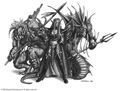
An artwork for Warcraft: The Roleplaying Game by Chris Metzen of a troll with fellow NPC races naga and blood elf.

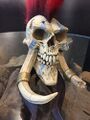
![A troll skull modeled by Blizzard's Creative Development group.[119]](/wiki/File:Headhunter_Skull.jpg)


Warcraft III
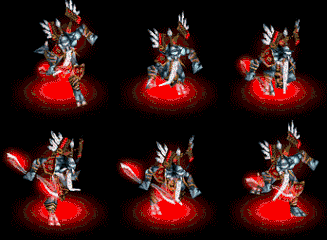
Troll Shadowhunter
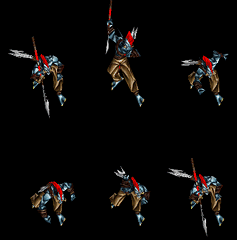
Troll Headhunter
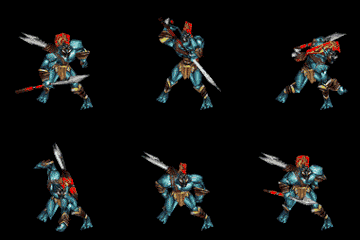
Troll Berserker
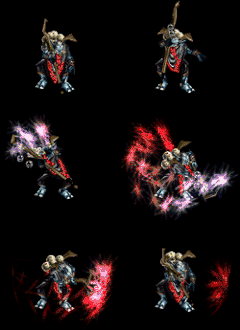
Troll Witch Doctor
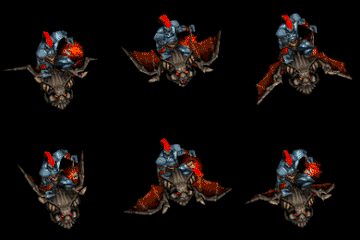
Batrider

Troll axethrowers

Troll priest
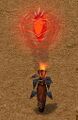
Serpent Ward


.gif)


Fan art
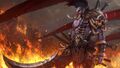
Art of a troll headhunter by Samarskiy on DeviantArt.
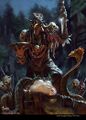
Art of a sacrificial ceremony by bayardwu on DeviantArt.
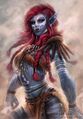
Art of "Kih", a female jungle troll by DenaHelmi on DeviantArt.
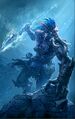
Art of a troll spearthrower by zhou he (brainlesszombie) on ArtStation.
.jpg)
.jpg)
.jpg)
.jpg)
See also
References
- ^ [10-35] Family Tree
- ^ [44] Screecher Spirits
- ^ Vol'jin: Shadows of the Horde, chapter 10, pg. 141
- ^ a b c d e World of Warcraft: Chronicle Volume 1, pg. 70
- ^ a b World of Warcraft: Chronicle Volume 1, pg. 71 - 72
- ^
 [Two-Toed Sandals]
- ^
 [Two-Toed Boots]
- ^ [Two-Toed Warboots]
- ^
 [Troll Feet]
- ^ a b World of Warcraft: Official Beginner's Guide, pg. 47
- ^ Height
- ^ a b c d Troll Compendium: Troll Traits
- ^ a b Troll Compendium: Forest Trolls
- ^ a b c Troll Compendium: Jungle Trolls
- ^ Vol'jin: Shadows of the Horde, pg. 56
- ^ a b Troll Compendium/Troll Traits#Health
- ^ a b Vol'jin: Shadows of the Horde, pg. 145, 146
- ^ a b [10-60] The Great Hat Robbery
- ^ a b c d e Ask CDev Answers - Round 2
- ^ Vol'jin: Shadows of the Horde, pg. 116, 117
- ^ [40] Gearing Up
- ^ Vol'jin: Shadows of the Horde, pg. 285, 286
- ^ Vol'jin: Shadows of the Horde, pg. 124
- ^
 [10-50] Lending a Hand
- ^ Vol'jin: Shadows of the Horde, pg. 8
- ^ a b [15-35] Regeneration Takes Time
- ^ Haunted War Drum#History
- ^ Gri'lek's Adventure Guide
- ^ a b [Arathor and the Troll Wars]
- ^ Tides of Darkness, chapter 4
- ^ Vol'jin: Shadows of the Horde, pg. 117
- ^ [50-70] Looking for Lukou
- ^
 [Fistful of Blood]
- ^ Warcraft II: Tides of Darkness manual, Orc Buildings, Troll Lumber Mill
- ^ a b Vol'jin: Shadows of the Horde, pg. 226, 254, 255, 258
- ^ World of Warcraft: War of the Scaleborn
- ^ Ancient Nazmani Tablet
- ^ King Dazar#Adventure Guide
- ^
 [Embellished Tusk Band]
- ^ a b Vol'jin: Shadows of the Horde, pg. 200
- ^ World of Warcraft: Chronicle Volume 1, pg. 70 - 71
- ^ Word of the Conclave
- ^ a b c d e f Troll Compendium: Early Troll Civilization
- ^ World of Warcraft: The Magazine Volume 2 Issue 1
- ^ [The Twin Empires]
- ^ Troll Compendium/Are Trolls Related to Night Elves?
- ^
 [60] In Darkest Night
- ^ Troll Compendium/Early Troll Civilization
- ^ a b The Sundering, chapter 8, pg. 67
- ^ [The Founding of Quel'Thalas]
- ^ World of Warcraft: Chronicle Volume 1, pg. 138
- ^ a b Patch 4.1.0#Trailer
- ^ Traveler: The Spiral Path, pg. 332 - 333
- ^ a b Troll Compendium: Zandalar Tribe
- ^ http://us.battle.net/wow/en/zone/zulgurub/
- ^ World of Warcraft: Chronicle Volume 3, pg. 325
- ^ Underdev/Echo Isles
- ^ Zul'Farrak Zombie
- ^ Mummified Troll Remains
- ^ Reanimated Drakkari Tribesman
- ^
 [Urn of Passage]
- ^
 [Zandalari Voodoo Doll]
- ^ Shadows of the Loa
- ^
 [Gahz'rooki's Summoning Stone]
- ^
 [Bracelet of Jade and Coins]
- ^
 [Fine Bloodscalp Dinnerware]
- ^
 [Jade Asp with Ruby Eyes]
- ^
 [Haunted War Drum]
- ^
 [Voodoo Figurine]
- ^ Troll lodge concept art, troll lumber mill
- ^ Blood of the Highborne
- ^ Troll Headhunter (Warcraft III)
- ^ [53] Krom'Grul
- ^
 [Matching Tusk Rings]
- ^
 [Tusk Wax]
- ^ Drakkari Colossus#Adventure Guide
- ^ [Voodoo Figurine]
- ^
 [Zandalari Spiritstone]
- ^ Spirit-Bound Sentry
- ^ Soul-Fed Construct
- ^ Troll Compendium/Other Trolls
- ^ World of Warcraft: Exploring Azeroth: The Eastern Kingdoms, pg. 37
- ^ Swift Blue, Swift Purple, Swift Olive and Swift Orange Raptors
- ^ Binding Raptors
- ^ The More, the Scarier
- ^ a b World of Warcraft: Chronicle Volume 1, pg. 93
- ^ World of Warcraft: Chronicle Volume 1, pg. 77
- ^ Troll Compendium: Dark Trolls
- ^ Frost King Malakk
- ^ World of Warcraft: Chronicle Volume 1, pg. 73, 74
- ^ World of Warcraft: Chronicle Volume 1, pg. 76
- ^ Troll Compendium: Ice Trolls
- ^ Troll Compendium: Ice Troll Tribes
- ^ Troll Compendium: Gurubashi Tribe
- ^ Countdown to Extinction (WC3 demo)
- ^ Before completing the quest [10-40] The Real Prey
Darkspear Headhunter says: Who in charge thought island trolls be good for a frozen land war? - ^ Troll Compendium: Sand Trolls
- ^ Troll Compendium: Sand Troll Tribes
- ^ Dave Kosak on Twitter - "We had never had the art to depict them as we envisioned, but made the time to do it in 5.2."
- ^
 [Sanguinating Totem]
- ^ The Golden Serpent#Adventure Guide
- ^ The Last Guardian, pg. 10, 31-32, 98-103, 107, 162, 174
- ^ Troll Compendium
- ^ Countdown to Extinction
- ^ Day of the Dragon, pg. 254
- ^ Lands of Mystery, pg. 81 - 83
- ^ Alliance Player's Guide, pg. 179
- ^ a b Monster Guide, pg. 138
- ^ Lands of Mystery, pg. 81
- ^ World of Warcraft: The Magazine Volume 2 Issue 1, Ancients and others lineage chart
- ^
 [The Third Troll Legend]
- ^ World of Warcraft at BlizzCon 2017
- ^ [Time-Corroded Breastplate]
- ^ Chieftain Zul'Marosh
- ^ File:Forest troll.jpg
- ^ File:Ice Troll by Samwise.jpg
- ^ [Brittle Chitinous Shoulderpads]
- ^
 [The Greatest Race of Hunters]
- ^
 Nebu 2018-04-24. Life at Blizzard: Behold the Headhunter Skull!. Blizzard Entertainment. Retrieved on 2018-04-28.


| |||||||||||||||||||||||||||||
| |||||||||||||||||||||||||||||||||||
es:Trol