
Gurubashi tribe
 Gurubashi tribe Gurubashi tribe | |
|---|---|
 | |
| Main leader | Unknown |
| Formerly |
 High Priestess Mar'li † High Priestess Mar'li † Jin'do † Bloodlord Mandokir[1] † Zan'non † Jok'non † Jin'do † Bloodlord Mandokir[1] † Zan'non † Jok'non † |
| Secondary leaders | Unknown |
| Formerly |
Zanzil the Outcast † High Priestess Kilnara † High Priestess Kilnara † High Priest Venoxis † High Priestess Jeklik † High Priest Thekal † High Priestess Arlokk † High Priest Venoxis † High Priestess Jeklik † High Priest Thekal † High Priestess Arlokk † |
| Race(s) |
Jungle troll Dire troll Dire troll |
| Character classes | Berserker, High priest, Shadow priest, Warlord |
| Capital | Zul'Gurub |
| Base of operations | Tal'gurub |
| Theater of operations | Stranglethorn Vale, Zuldazar |
| Formerly | Kun-Lai Summit, Throne of Thunder |
| Language(s) | Zandali |
| Affiliation | Independent, Zandalari Empire |
| Formerly | Empire of Zul |
| Status | Active |
The Gurubashi tribe, pronounced [GOO-roo-bah-shee], is the remnant of the Gurubashi Empire and is the strongest tribe of jungle trolls. They reside in their capital of Zul'Gurub.
History
The Gurubashi civil war

Established long before the Great Sundering, the Gurubashi Empire took its name from the strongest tribe of jungle trolls at the time. The jungle trolls ruled the southern jungles of ancient Kalimdor until the Burning Legion's first invasion, which wrought havoc and devastation throughout the continent and culminated in the Great Sundering.
The long centuries following the Sundering were difficult ones for the troll race. 1,500 years before the opening of the Dark Portal,[2] the jungle trolls, driven to desperate ends, enlisted the aid of the god Hakkar the Soulflayer. Hakkar brought the trolls great power, but in return, the bloodthirsty god required that souls be sacrificed to him.
His demands quickly escalated, and he grew impatient with his loyal priests, the Hakkari. He told them to find a way to summon him physically into the world, so that he might directly drain the blood of his victims. Most of the Hakkari were horrified at the idea, but the Atal'ai, a small extremist faction of the Hakkari, decided to do as Hakkar wished.
Before the Atal'ai could complete the summoning, the other jungle trolls, including the Hakkari, rose up in open revolt against the cruel god. Even the Zandalar tribe was drawn into the conflict, which finally ended with the destruction of Hakkar’s avatar. Driven from the jungles, the Atal'ai were hunted nearly to extinction. Yet a small group of Atal'ai escaped into the Swamp of Sorrows, where they secretly built a great temple to their god: the Temple of Atal'Hakkar. The other jungle tribes, including the Gurubashi, then turn on the Hakkari and killed or exiled for them evil deeds they had done in Hakkar's name, even though they had fought the Atal'ai. The surviving Hakkari would join the remaining Atal'ai in their temple.[3]
The Gurubashi War
Years after the Gnoll War, Stormwind's farmers and settlers would increasingly push southward claiming territory close to the jungles of Stranglethorn Vale. Skirmishes would erupt between the Gurubashi and Stormwind forces but the elderly Barathen would refuse to order an invasion into Stranglethorn and was focused on fighting a defensive war, much to the outrage of his son Prince Llane. While King Barathen's strategy against the Gurubashi was effective it would be unable to stop every attack, one which saw slow, barbaric, and gruesome deaths delivered to the villagers of three towns in Westfall. This would ultimately prove to be the final straw of Prince Llane, Anduin Lothar and Medivh, who in defiance of his father's continued de-escalation, journeyed south to bring war to the Gurubashi. Though initially shielded by Medivh's magic the three friends would end up in the fight for their lives when they battled Jok'non, a Gurubashi Warlord empowered by Hakkar the Soulflayer. Ultimately the three friends would prove victorious and return to Stormwind, shaken by Medivh's powers.
While none of the Gurubashi who witnessed Jok'non's death survived, it took very little to the imagination for the trolls to see who was responsible. Rallying under Jok'non's son, Zan'non, the Gurubashi launched an invasion intent on destroying Stormwind. In the face of the troll onslaught, Barathen recalled all his forces to the stronghold's gate, believing that the survival of Stormwind would depend on one colossal battle. As the death toll mounted on both sides Barathen mounted a desperate counterattack against the Gurubashi. Though almost succeeding in claiming Zan'non's head, Barathen would die on the field of battle. Llane, driven by guilt, would plead with Medivh to unleash his power on the Gurubashi as he has done against Jok'non. Though frightened of his power Medivh would accept Llane's request and destroy the Gurubashi forces (Zan'non included), an act that would ultimately avenge Barathen.[4]
Horde resistance
When the Orcish Horde invaded Azeroth most of their forces war against the humans of Stormwind. However Kilrogg led his Bleeding Hollow clan into Stranglethorn Vale, which reminded the orcs of their ancestral home of Tanaan. Thus the Bleeding Hollow were determined to claim Stranglethorn for themselves, however, the Gurubashi refused to share their lands with outsiders and the two forces would clash in battle. Though the Gurubashi were weakened by the Gurubashi War their knowledge of the land allowed for them to launch a guerrilla campaign to drive the invading Bleeding Hollow out of the region. Kilrogg and his Bleeding Hollow would eventually be ordered to retreat by Warchief Blackhand after he learned of the conflict and concluded that too many orcs were dying for no apparent gain.[5]
The Soulflayer's return

After Hakkar's avatar in Zul'Gurub was destroyed, things within Stranglethorn would settle down. However, over time the Gurubashi lost much of its power and prestige. At some point, the Gurubashi exiled Zanzil from the tribe and actually spit and threw stones at him. Even though the Gurubashi never gave a definite reason for their actions, it was possible that Zanzil was making other Gurubashi his mind slaves. Following this, the Gurubashi would live their own lives in relative peace and not bother the other Jungle tribes in the region like the Bloodscalp tribe and the Skullsplitter tribe, who wared with each other. They didn't even raise a fuss when the Darkspear tribe returned and helped the Horde create the Grom'gol Base Camp. The Gurubashi's isolationist policy would end when word reached them that that the Atal'ai and Hakkari were able to successfully resurrect Hakkar the Soulflayer within Zul'Gurub. Eager to prove themselves and return to their former glory the Gurubashi returned to the capital and pledged their allegiance to the Soulflayer.
The Gurubashi tribe guarded Hakkar and his minions with reckless fervor, believing that the Gurubashi empire would be restored in return for their loyalty. They are so driven to reach such former glory that they don't seem to care that Hakkar has enthralled five high priests of the trolls' primal gods. When word of Hakkar's presence reached the Zandalar tribe in the South Seas, they were horrified to discover the enslavement of their kindred, the Zandalari high priests. King Rastakhan then sent emissaries from the island of Zandalar to the Eastern Kingdoms, where the trolls recruited champions from Azeroth's many races in the hopes that Hakkar would once again be defeated.[3]
The Zandalari's call to arms was answered by the proud defends of Azeroth who ventured into the Zul'Gurub and killed many of Gurubashi and ultimately defeated Hakkar. Even the five high priests High Priest Venoxis, High Priestess Jeklik, High Priestess Arlokk, High Priest Thekal, and High Priestess Mar'li and the hydra Gahz'ranka were slain.[6] While Bloodlord Mandokir survived the assault he would later be tortured to death by the Bloodscalp tribe. The surviving Gurubashi would be led by Jin'do and remain in Zul'Gurub.
Cataclysm

The tribe is apparently willing to work with the Dark Horde, as they were requested for a witch doctor to come and sacrifice one of the Bravo Company, Krakauer, in a dark ritual. Their ritualist, Ritualist Tarak, was slain by an adventurer and two members of the Company, Jorgensen and Messner, before the ritual was complete.[7]
When the Cataclysm struck the land, the Gurubashi remained holed up in Zul'Gurub where Jin'do began implementing a plan to return Hakkar to the world. Jin'do's plan would see the Gurubashi membership increase thanks to the aid of adventurers and Ohgan'aka who helped bring Bloodlord Mandokir back to life, and Jin'do would recruit Zanzil back into the fold. Zanzil would then go on to attempt to resurrect High Priest Venoxis and High Priestess Jeklik, though only Venoxis would return to life as adventurers thwarted Jeklik's resurrection. Meanwhile, High Priestess Arlokk's sister Kilnara has risen to the position of High Priestess and aids Jin'do in his plans.
The Gurubashi would later gain unexpected help from the Zandalar tribe when the mysterious prophet only known as Zul issued a call for Azeroth's embattled troll populations to unite into a single empire. Accompanied by members of the Gurubashi Jin'do arrived at a meeting in Zandalar where he, Daakara and the Amani and Vol'jin and the Darkspear, and an unknown Ice troll were told by Zul about Zul'Drak being lost to the Scourge and how Zul'Farrak is now a wasteland. They are told that the Zandalari plan to reclaim the former glory of the troll race, will crush any who stand in their way and states that the Troll Empire will rise again. The Gurubashi represents cheer and accept the Zandalari's offer.[8] Vol'jin who views the Horde as his true brothers sends members of his tribe to both Orgrimmar and Stormwind recognizing that the threat of new troll empire is something that the Horde can't handle alone. While Vol'jin is able to gather a mobile force to keep the Amani from surging out of Zul'Aman, he is unable to contain the Gurubashi.
During the war against the Zandalari, in Northern Stranglethorn Bambala, Fort Livingston, Nesingwary's Expedition, Grom'gol Base Camp and the Rebel Camp come under attack by serpents sent by High Priest Venoxis. High Priestess Kilnara sends panthers to attack the Rebel Camp and Grom'gol while the panther Mauti attacks the hunters at Nesingwary's Expedition. Both Grom'gol and the Rebel Camp later come attack by Gurubashi trolls led by Bloodlord Mandokir. After heroes of the Horde and Alliance beat back the Gurubashi attack they are sent to the Cape of Stranglethorn which faces its own troubles.
Zanzil the Outcast aids the Gurubashi by turning the inhabitants of both Hardwrench Hideaway and the Explorers' League Digsite into voodoo zombies by poisoning the food in each town. After saving their respective towns adventurers will be sent to speak to a troll who is warning Baron Revilgaz and Booty Bay about the Gurubashi. This troll turns out to be none other than Vol'jin, the Darkspear leader himself.[9]
Darkspear agents inside Zul'Gurub have discovered that Jin'do is wrestling Hakkar the Soulflayer into submission, holding him by spirit chains and stripping out his power into himself. They enlist adventurers to put an end to Jin'do's mad plans once and for all.[10] Upon destroying the spiritual chains holding the Soulflayer in place, Hakkar turns upon Jin'do, and utterly destroys him, leaving only the corpse of Jin'do the Broken. Hakkar then returns the adventurers to the mortal realm, promising to deal with them another time, before vanishing. Though Hakkar is free, the Zandalari have lost their hold on Zul'Gurub, while the Gurubashi was dealt a severe blow that it may not recover from.
Mists of Pandaria

The Gurubashi were part of the Zandalari Invaders, attacking the northern shores of Pandaria, along with the Amani, Drakkari and Farraki tribes. They make an appearance in the quests related to the resurrection of Lei Shen, and later appeared as part of Horridon fight in Throne of Thunder raid. Their leader, High Priestess Mar'li, was slain during the Council of Elders fight.
Battle for Azeroth

Gurubashi Thugs harassed the merchants at Port of Zandalar after the Horde was allowed to come into the area. They, as well as Amani and Sandfury Thugs, were put down by Horde adventurers. Tal'gurub in Zuldazar is a Gurubashi enclave in Zandalar. Vol'jamba, a Zandalari troll, took over Tal'gurub and enslaved the minds of the Gurubashi residents. The ghosts were aided by Horde adventurers, and the living residents were also freed from mindslavery.
They later appeared at the Speaker's Step, having worked themselves into a murderous rampage. An adventurer culled them. They apparently developed a mental weakness since the rise and fall of Hakkar.[11] Part of the reason why they were upset was because the Darkspear had been granted an embassy in Dazar'alor, despite the Horde having helped them against the Jambani.[12]
Members
| Name | Role | Condition | Location |
|---|---|---|---|
 High Priestess Mar'li High Priestess Mar'li
|
Hight prietress of Shadra, Leader of the tribe and Member of the Council of Elders | Deceased - Killable (Wow) | Lightning Promenade, Throne of Thunder |
 Jin'do Jin'do
|
Leader of Hakkari and former leader of the tribe | Deceased - Killable (Wow) | Altar of the Blood God, Zul'Gurub |
| Bloodlord Mandokir
|
Former lord of the tribe | Deceased - Killable (Wow) | Mandokir's Domain, Zul'Gurub |
| Zanzil the Outcast
|
Leader of Zanzil, responsible of the resurection of members of the tribe. | Deceased - Killable (Wow) | The Devil's Terrace, Zul'Gurub |
Culture
- Main article: Jungle troll
Razzashi raptors are among the cleverest predators in the jungle, making them favored by the Gurubashi trolls.[13] The only known Razzashi Raptors were said to have been in the custody of Bloodlord Mandokir in Zul'Gurub. This species of raptor has not been seen in many years.[14] The purebred royal raptors of Zul'Gurub, these mounts have become a rare sight in Stranglethorn Vale. The Gurubashi have been known to fly into a rage at the sight of any non-troll riding one of their precious beasts.[15]
The Black War Raptor is bred from the same vicious line that sired Ohgan and brought victory to the Gurubashi Empire.[16]
Stranglethorn's Gurubashi trolls often capture powerful snakes to keep as pets or to cook as meals.[17]
Notes and trivia
- The Gurubashi tribe was originally meant to have a larger role to play in Zandalar than they did.
- Several unused NPCs are in the game's files, namely, Ambassador Shala, who uses the same model as Mar'li. Other NPCs include Embassy Headhunters, and Enraged Headhunters.
- All of these NPCs are notably tagged with Gurubashi Empire, rather than the tribe.
- Gurubashi trolls have been inconsistently displayed over the years; when they were first encountered, they appeared physically similar to all other jungle troll tribes, having various shades of blue and light green skin along with thin, lithe bodies.
- However, for an unknown reason, ever since the Rise of the Zandalari, Gurubashi trolls have appeared in different ways. While the jungle troll model and skin tones are still commonly used, they are not the only depiction. Several trolls such as the Gurubashi Warmongers and Gurubashi Workers appear with forest troll models; which have become a somewhat common appearance for Gurubashi trolls ever since, even showing up at the Throne of Thunder.[18]
- Witch Doctor Qu'in and a few others have dark skin, which some speculate to have been added for dark trolls.
- Meanwhile some Gurubashi like Venomancer T'Kulu and Venomancer Mauri, including venom priests that appear during the Horridon fight, have the pinkish skin of the old Zandalari trolls.
- The Gurubashi tribe appeared on Zandalar in Battle for Azeroth, this time having only jungle troll models and skin tones during their main questline appearances. However, their dire trolls had a shade of green skin most commonly seen on forest trolls.[19] Their appearance in the world quest,
 [50WQ] Hundred Troll Holdout, once again depicts them with forest troll skin tones; though this time with jungle troll models.
- The name Gurubashi may refer to either the Gurunsi peoples of modern-day Ghana and/or the homophone Arabic word ghuroob, which means sunset.
Gallery
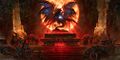
Hakkar and his Gurubashi minions.

See also
References
- ^ Troll Compendium/Jungle Troll Tribes#Gurubashi Tribe
- ^ World of Warcraft: Chronicle Volume 1, pg. 138
- ^ a b The Troll Compendium: The Gurubashi
- ^ World of Warcraft: Chronicle Volume 2, pg. 106 - 111
- ^ World of Warcraft: Chronicle Volume 2, pg. 106 - 125
- ^ Patch 1.7.0
- ^
 [7-30] Krakauer
- ^ Rise of the Zandalari trailer
- ^ Rise of the Zandalari quest chain
- ^
 [35H] Break the Godbreaker
- ^ [50WQ] Hundred Troll Holdout
- ^ Gurubashi Berserker (Zuldazar)
- ^
 [Razzashi Hatchling]
- ^ Mount Journal entry for
 [Swift Razzashi Raptor]
- ^ Mount Journal entry for [Armored Razzashi Raptor]
- ^ Mount Journal entry for [Whistle of the Black War Raptor]
- ^ Tree Python
- ^ Gurubashi Berserker
- ^ Gurubashi Berserker (Zuldazar)
| |||||||||||||||||||||||||||||


